Q&A
VEX V5 Robotics Competition 2026-2027: Override
معلوم: R4
Welcome to the official VEX V5 Robotics Competition Question & Answer system, where all registered teams have the opportunity to ask for official rules interpretations and clarifications. This Q&A system is the only source for official V5RC rules clarifications, and the clarifications made here from the Game Design Committee (GDC) are considered as official and binding as the written Game Manual itself.
Please review the Q&A Usage Guidelines before posting. This system is only intended for specific V5RC game rules questions.
- For event, registration, or other competition support questions, please contact your Program Support Manager.
- For VEX technical support, contact [email protected] or [email protected].
- For game questions, suggestions, or concerns outside of specific and official rules questions, contact [email protected]
الفهرس
- Height IQ
- Tetherbots and R4
- Important Starting Size Clarification
- Touching the Sides of Sizing Tool During Inspection
- Starting Match With the Preload in the Robot
- Robot Size and Starting Posistion Problem
- Robot Size Rules Clarification
- Fixed Location definition
- License Plate Mounting Clarification
- R4 & SG2 Robot Status during size measurement for inspection
- Removal or Modification of Subsystem 3 - Inspection Clarification
- Fitting in the sizing tool
- Robot sizing
- R4 Robot inspection configuration
- Are cables considered for size & parking?
- Interaction with Green Cube when Placing Robot in Starting Position
- <R4> Using External Factors to Stay In Size
- Robot head orientation in starting configuration
- Can robots start away from the field perimeter?
- Field Displays <S2> <S1> <R4>
755: Height IQ
Can the robot height be more than 15 inches? or is it just at the start at 15 and then can extend further when match begins?
تم الرد بواسطة committee
Please review the Q&A Usage Guidelines before posting, specifically point 3, "Quote the applicable rule from the latest version of the manual in your question". Often, you'll find that by quoting the rule, you'll answer your own question.
Robot height is governed by rule G4, which reads as follows, with a few portions bolded for emphasis:
<G4> Pre-match setup. At the beginning of a Match, each Robot must meet the following criteria:
Only be contacting the Floor and/or the field perimeter.
Fit within an 11” x 19” (279.4mm x 482.6mm) area, bounded by the Starting Positions.
Be no taller than 15” from the Floor.
An offending Robot will be removed from the Match at the Head Referee’s discretion. They will not receive a Disqualification, but they will not be permitted to play in the Match.
Note 1: Robots must be placed on the field promptly. Repeated failure to do so could result in a violation of <G1>.
Note 2: Robots may expand beyond their starting size constraints after the start of the Match.
The exact definition of the term “promptly” is at the discretion of the Head Referee and the Event Partner, who will consider event schedule, previous warnings or delays, etc. Once the Match starts, expansion is unlimited.
If this does not answer your question, please feel free to rephrase and re-submit.
605: Tetherbots and R4
R4 states:
Robots must be safe. The following types of mechanisms and components are NOT allowed: c. Those that pose an unnecessary risk of Entanglement
The definition of Entanglement states:
Entanglement – A Robot status. A Robot is Entangled if it has grabbed, hooked, or attached to an opposing Robot or a Field Element.
Say a Robot has multiple drive bases (known as a “tetherbot”) connected by V5 smart cables (the “tether”). In some past seasons it has been said that in order to satisfy R4c, the tether must be backed by a rigid material (see https://www.vexforum.com/t/answered-partner-minibot/27092 ). Is it still the case that tethers must be backed by a rigid material?
تم الرد بواسطة committee
Say a Robot has multiple drive bases (known as a “tetherbot”) connected by V5 smart cables (the “tether”). In some past seasons it has been said that in order to satisfy R4c, the tether must be backed by a rigid material (see https://www.vexforum.com/t/answered-partner-minibot/27092 ). Is it still the case that tethers must be backed by a rigid material?
R4 does not provide any specific build guidelines. To minimize any risks of confusion or conflict during inspection, Teams should make it abundantly clear to Head Referees that their Robots do not pose any unnecessary risks of Entanglement.
It is impossible to issue a blanket ruling that would encompass all hypothetical Robot designs (or, in this case, rigid backing materials). In most cases, "cable carriers" made of VEX metal are typically sufficient for satisfying R4. However, we are not going to provide a definition of "rigid" or a guaranteed/recommended build solution.
580: Important Starting Size Clarification
<G4> Robots begin the Match in the starting volume. At the beginning of a Match, each Robot must be smaller than a volume of 18” (457.2 mm) long by 18” (457.2 mm) wide by 18” (457.2 mm) tall. Using Field Elements, such as the field perimeter wall, to maintain starting size is only acceptable if the Robot would still satisfy the constraints of and pass inspection without the Field Element. Robots in violation of this limit will be removed from the field prior to the start of the Match, at the Head Referee’s discretion.
<R4> Robots must fit in a sizing box. At the beginning of any Match, Robots must be smaller than 18” (457.2 mm) long by 18” (457.2 mm) wide by 18” (457.2 mm) tall.
Q&A 439 https://events.vex.com/VRC/2019-2020/QA/439 Q&A 423 https://events.vex.com/VRC/2019-2020/QA/423
Although you have answered questions about starting size in the past (see q&a's listed above), we are still a bit confused on the legality of the situations drawn below.
A & B: The robot itself is in size, but the preload is out of 18” (length wise)
C : The robot itself is out of size (height wise because of its tray), while the preload is inside of the robot
We are mainly concerned with this: if you were to put the preload into your robot and by doing so it forces a section of your robot out of the 18"x18"x18" size (as seen in scenario C where the tray was forced outside by the preload), would that be a legal starting position. If you could clarify which starting positions are considered legal that would be very helpful. Thank you!

تم الرد بواسطة committee
First, thank you for quoting the relevant rules, searching for similar Q&A posts, and providing a clarifying image.
A & B: The robot itself is in size, but the preload is out of 18” (length wise)
These would both be legal. These are both scenarios that were intended to be covered by Q&A 439, as linked.
C : The robot itself is out of size (height wise because of its tray), while the preload is inside of the robot
This would not be legal.
Another way to word the response from Q&A 439 would be as follows:
G4 and R4 are intended to refer to Robot size only. The word 'Robot' refers to the VEX definition of 'Robot': "Anything that has passed inspection that a Team places on the field prior to the start of a Match." An inspection-passing Robot consists of VEX metal, wheels, gears, electronics, etc.
The hypothetical Robot C may have passed inspection (and therefore satisfied R4). Once it is placed on the field, the Head Referee is now checking its compliance with G4. Since some portion of the metal, wheels, gears, and electronics that make up the 'Robot' are now outside of the 18" x 18" x 18" size restriction, it is now in violation of G4.
561: Touching the Sides of Sizing Tool During Inspection
<R4> Robots must fit in the sizing box. At the start of each Match, the Robot must be able to satisfy the following constraints: a. Only be contacting the Floor and/or the Field Perimeter. b. Fit within an 11” x 19” (279.4mm x 482.6mm) area, bounded by the Starting Position. c. Be no taller than 15” from the Floor
When being sized, can a robot touch the sizing box walls or ceiling or the Robot Sizing Tool sides and still pass sizing inspection, or would this be considered out of size via R4? This has been a point of contention at some events for robots that are close to being out of size. Thank you.
تم الرد بواسطة committee
We believe this is the same question as this similar Q&A:
https://events.vex.com/VIQC/2019-2020/QA/558
If this is not the case, please feel free to rephrase and re-submit.
439: Starting Match With the Preload in the Robot
Good evening,
I have a question regarding the preload and how it may affect sizing at the beginning of the match. While reading R4 and G4, the rules state that the robot must be in the 18x18x18 constraint at the beginning of the match without mention of the preload. In Virginia tournaments, however, teams who are resized on the field are allowed to remove their preload and be measured. Is it legal for the robot itself to be out of size with the preload in the robot in the beginning of the match?
Thank you, Korvex Robotics
تم الرد بواسطة committee
Good morning. Please see this similar Q&A, which states that the Preload is not intended to be used when considering Robot size as it pertains to G4 and R4.
391: Robot Size and Starting Posistion Problem
Hi all, I spoke with are regional rep, and he directed me here for this question. I notice that there have been similiar problems but people didn't seem to realize what is causing the difficulties.
As stated in the following rules, the robot must be 11 x 19.
<G5> Expansion is limited during a Match. During the Match, Robots may not expand beyond the following restrictions: a. Horizontally, beyond an 11” x 19” (279.4mm x 482.6mm) area. b. Vertically, beyond the 15” (381mm) high starting requirement.
Also as stated by the following rule, it must fit inside the starting area of 11 x 19.
<R4> Robots must fit in the sizing box. At the start of each Match, the Robot must be able to satisfy the following constraints: a. Only be contacting the Floor and/or the Field Perimeter. b. Fit within an 11” x 19” (279.4mm x 482.6mm) area, bounded by the Starting Position. c. Be no taller than 15” from the Floor.
The problem that I have discovered is the following. The starting areas are NOT 11 x 19. On our two fields bought two years apart the starting areas for length and width are both about a 32nd of an inch short in either directions as shown in the two following pictures.
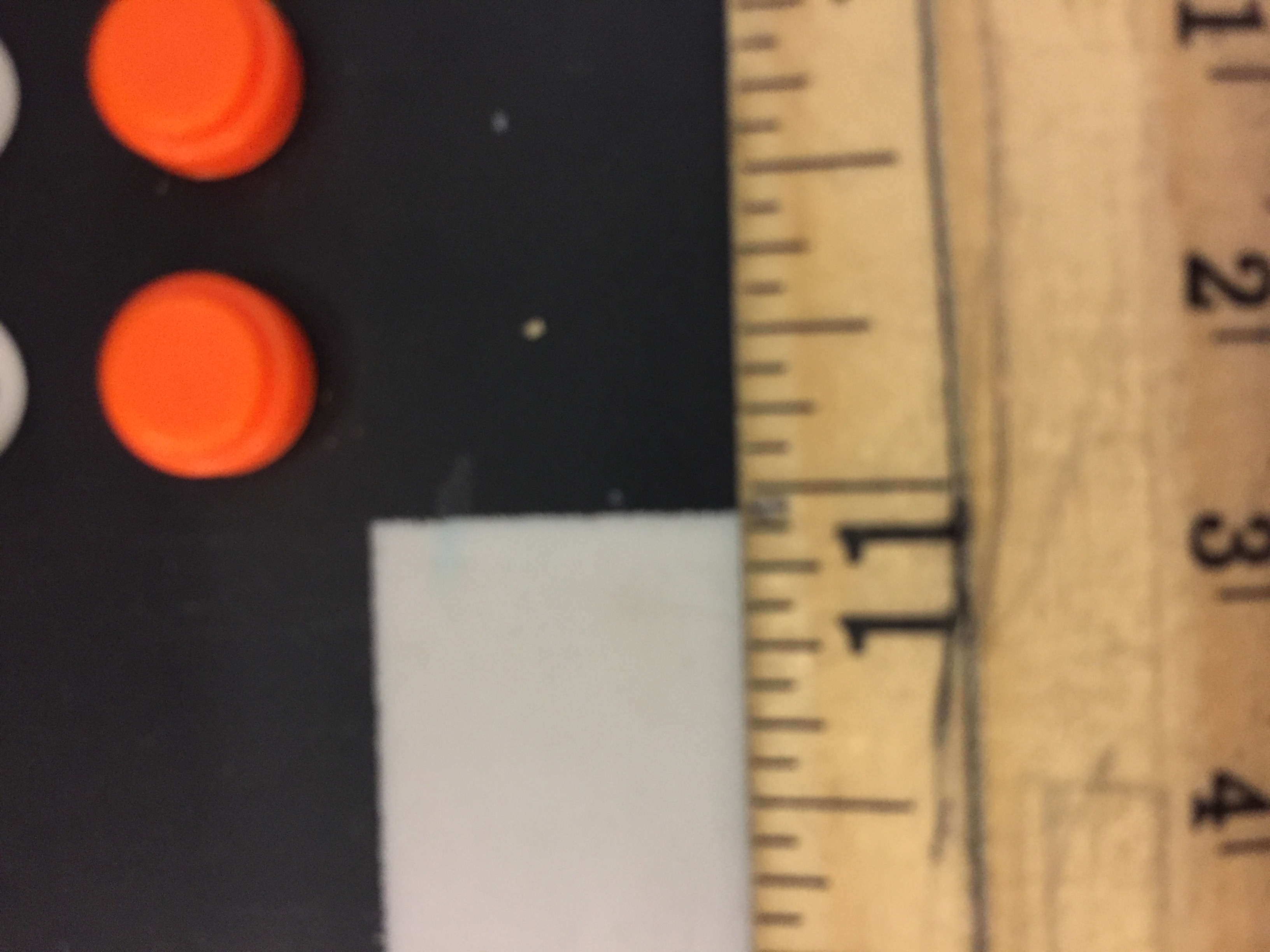
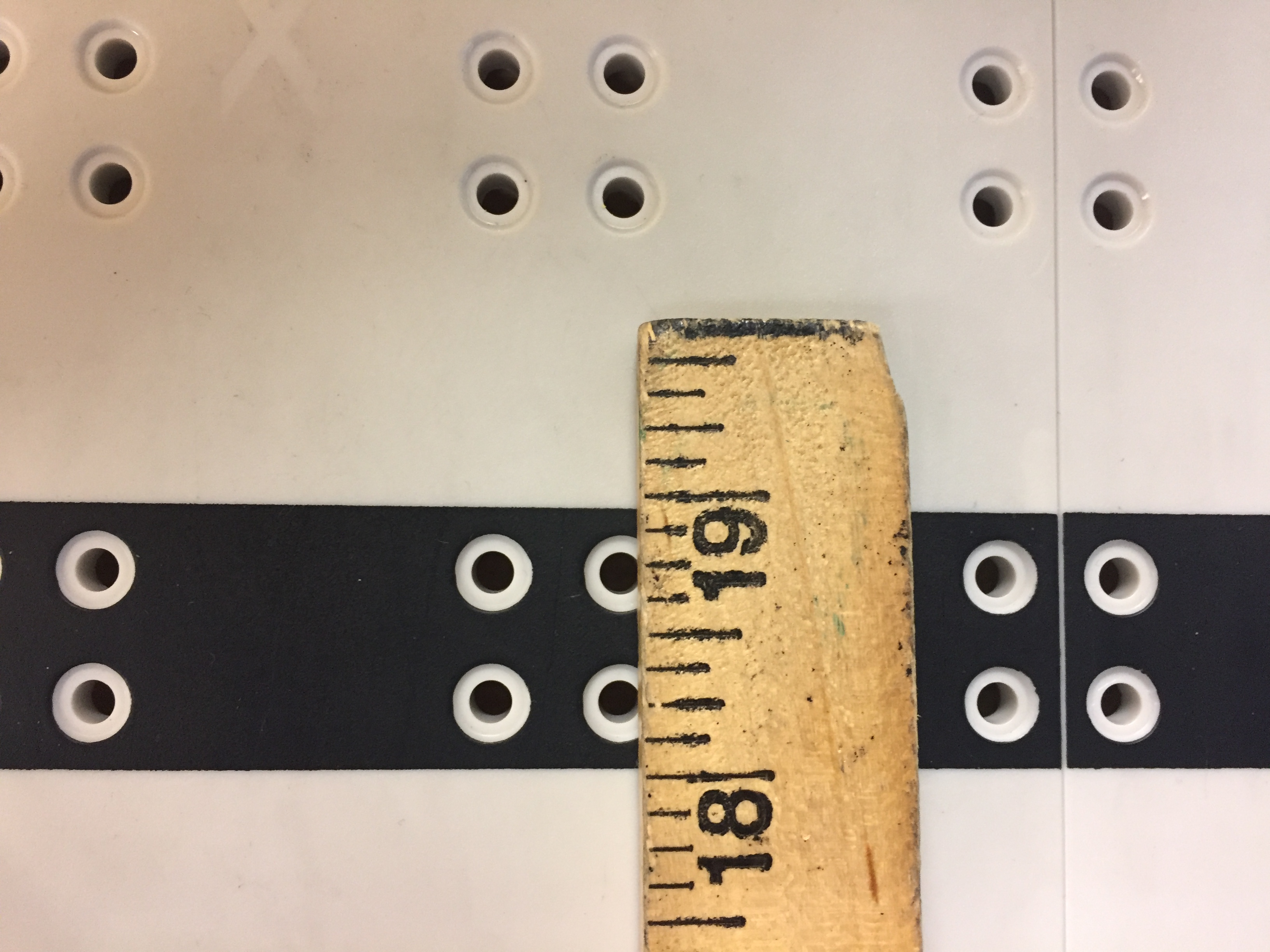
In previous years and games, this was not a problem. This year though the tolerances are very small. We have groups that have robots that are exactly 11 by 19. They would pass inspection (assuming the measuring device does not rely on the field which might have the same problems) but be ever so slightly outside of the starting positions. Their definitely needs to be a rules clarification on this.
Making the robot size smaller would not work. The way the pieces are made, the robot would have to be smaller in increments of 1/2 to 1/4 of an inch. This would make it much more difficult to incorporate everything needed to play the game effectively.
A rule addition allowing the robots to be slightly (thickness of an axel) outside the starting area as long as it passes inspection of course would be a good solution.
Thanks for the time.
Sam Schursky
Team 6277
The Harvey School
Katonah, New York
تم الرد بواسطة committee
First, please review this similar Q&A. Although it is asking a slightly different question than yours, it includes some relevant background information regarding Robot size rulings and tolerances.
https://events.vex.com/VIQC/2019-2020/QA/382
It looks like your root question is the following:
We have groups that have robots that are exactly 11 by 19. They would pass inspection (assuming the measuring device does not rely on the field which might have the same problems) but be ever so slightly outside of the starting positions. Their definitely needs to be a rules clarification on this.
A rule addition allowing the robots to be slightly (thickness of an axel) outside the starting area as long as it passes inspection of course would be a good solution.
Thank you for your suggestion, but this rule addition will not be made. The intents of VIQC's sizing rules are for Robot size to be checked during inspection and then enforced at the beginning of each Match. Having a different sizing rule for a Match vs inspection would negate the purpose of the inspection process.
They would pass inspection (assuming the measuring device does not rely on the field which might have the same problems) but be ever so slightly outside of the starting positions.
The official VIQC Sizing Tool does utilize the field as its reference. Relying on a common field ensures a standardized expectation for Teams, inspectors, and Head Referees, regardless of which event they attend. Some manufacturing variance is to be expected in any physical product, as is variance if using different measuring methods.
For example, the VIQC Field Perimeter has a very slight draft angle as an injection molded plastic part; so, if you lay a ruler from the perimeter to the black line, a difference of less than 1mm could easily occur depending on where you rest the ruler against the wall.
So, as an overarching answer to this question, we are going to refer to rule G3:
<G3> Use common sense. When reading and applying the various rules in this document, please remember that common sense always applies in the VEX IQ Challenge.
The intent of G4, G5, R5, and R6 is to provide a design constraint in the form of Robot size that is reasonably observable by a volunteer inspector/referee, and consistently enforceable across all events worldwide. It is not a reasonable expectation for an event to use digital calipers to measure Robot size; it is a reasonable expectation for an event to use the tools that are available to all Teams, such as a standard field, a publicly available physical sizing tool, and human observation. To avoid potential conflicts, we would advise Teams remind mindful of these realities when designing their VEX IQ Robots such that they do not rely on a possible variance of 0.03" to determine their legality.
382: Robot Size Rules Clarification
Can clarity please be provided as to which rule ultimately governs the size of the robot? Our teams' robots are 11” wide. How should rule R4 be interpreted with respect to R5?
At a recent tournament, my team was told by the lead inspector that regardless if their robot passes inspection, if the referees determine that the robot is not within the 11" by 19" starting position on the game field floor, then the match would not start until it is or the team will be disqualified. I was told that the referees would use being able to see the enclosed white floor area around the robot to make that determination. This is subjective in nature considering that if the part of the robot that is 11” wide is not contacting the floor. To truly make this assessment, the referees will need to have a starting position measuring tool.
At a recent league event, my teams' robots passed inspection and were not told of this starting position ruling at match time.
For the past 5 years that we have been fortunate to compete in the VEX IQ Challenge, as well qualifying for 4 World Championships, we have never encountered this interpretation of the robot sizing for the matches. It has been that as long as the robot passes inspection and as long as the driver placed their team’s robot the best possible into the starting position at the start and during the match, no one is disqualified and the match starts and/or continues.
Also, regarding VEX IQ Robot Sizing Tool part no. 228-5293, although not stated, will it be used as the official measuring tool at World Championship? More importantly, may it be stated that this is the official tool to use for robot sizing?
Thanks in advance James Ibanez
تم الرد بواسطة committee
Can clarity please be provided as to which rule ultimately governs the size of the robot? Our teams' robots are 11” wide. How should rule R4 be interpreted with respect to R5? [...] At a recent tournament, my team was told by the lead inspector that regardless if their robot passes inspection, if the referees determine that the robot is not within the 11" by 19" starting position on the game field floor, then the match would not start until it is or the team will be disqualified.
R4 states the following, with a portion bolded for emphasis:
<R4> Robots must fit in the sizing box. At the start of each Match, the Robot must be able to satisfy the following constraints:
a. Only be contacting the Floor and/or the Field Perimeter.
b. Fit within an 11” x 19” (279.4mm x 482.6mm) area, bounded by the Starting Position.
c. Be no taller than 15” from the Floor.
This rule works in conjunction with <G4>. <R4> is an “inspection rule”, meaning that a Robot may not pass inspection if it cannot satisfy these constraints. However, <G4> is a “game rule”, meaning that even if a Robot passed <R4> in inspection (i.e. it is theoretically capable of satisfying the constraints), Head Referees will still be watching for it before each Match.
G4 states the following, with a portion bolded for emphasis:
<G4> Pre-match setup. At the beginning of a Match, each Robot must meet the following criteria:
a. Only be contacting the Floor and/or Field Perimeter.
b. Fit within an 11” x 19” (279.4mm x 482.6mm) area, bounded by the Starting Position.
c. Be no taller than 15” from the Floor.
> An offending Robot will be removed from the Match at the Head Referee’s discretion. They will not receive a Disqualification, but they will not be permitted to play in the Match.
Note: Robots must be placed on the Field promptly. Repeated failure to do so could result in a violation of <G1>.
The exact definition of the term “promptly” is at the discretion of the Head Referee and the Event Partner, who will consider event schedule, previous warnings or delays, etc.
The Head Referee and inspector's interpretation of R4 at your event was correct. A Robot which has passed inspection must still demonstrably abide by G4 in each of their Matches.
Violation of G4 is not intended to escalate to an immediate Disqualification, but the Robot in question should not be permitted to play in the Match. However, excessive delays caused by non-compliance may still result in a violation of G1 as stated in the Note.
I was told that the referees would use being able to see the enclosed white floor area around the robot to make that determination. This is subjective in nature considering that if the part of the robot that is 11” wide is not contacting the floor. To truly make this assessment, the referees will need to have a starting position measuring tool.
There is no required method by which Head Referees are expected to enforce G4. In most cases, the visual check you describe should prove sufficient. However, for a Robot which pushes the limit of allowable size, a measuring tool could be as simple as sliding a VEX IQ beam or plate along the edges of the Starting Position. (the crossbar of the VEX IQ Challenge Sizing Tool, turned vertically, could also be used)
Also, regarding VEX IQ Robot Sizing Tool part no. 228-5293, although not stated, will it be used as the official measuring tool at World Championship? More importantly, may it be stated that this is the official tool to use for robot sizing?
We will confirm this in the April 10th Game Manual Update, which usually includes any specific rule changes or clarifications pertaining to the World Championship.
3266: Fixed Location definition
Referencing specifically the definition of "fixed location" in part a of R4. Does this mean that license plates must be attached to a part that doesn't move, or does it mean that it doesn't move from the part that it is attached to?
Example of each would be:
- License plates are attached to the drive train or a support beam and consistently stay at relatively the same height throughout the entirety of the match
- License plates are attached to a claw arm and remain fixed to the claw arm, but move up and down throughout the match as the arm moves up and down
Are both of these two examples legal?
تم الرد بواسطة committee
This is clarified in <R4.a.i>:
i. License plates should be mounted in locations that remain stationary on the Robot during a Match (e.g., not on a rotating intake or flipping manipulator). The function of license plates is to identify Robots for referees, spectators, and other Teams. Identification is harder when a license plate on a Robot moves during a Match.
Your first example would be legal, since the license plates would be mounted in a fixed/stationary position on the Robot. Your second example would not be legal, since the license plates would be mounted on a mechanism that is moving/lifting/rotating (i.e., a non-stationary mounting location).
3265: License Plate Mounting Clarification
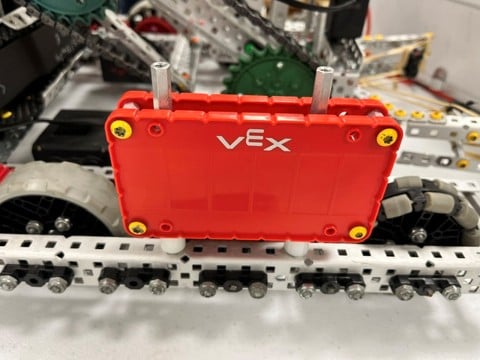
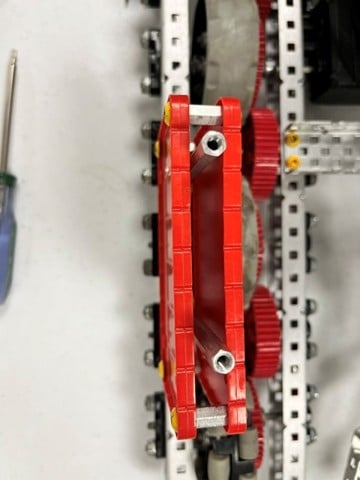
<R4><R4> Are we able to attach license plates like this and be in compliance with R4? They use 2 standoffs to slide the license plates over. They use a 2nd blank license plate (so use 4 of each color) to create a single license plate. It isn't being used for anything other than team number display and the 2nd plate is blank.
What if they use metal instead of a second plate - would they way they attach it to the robot (slipping over 2 standoffs) be considered secure?
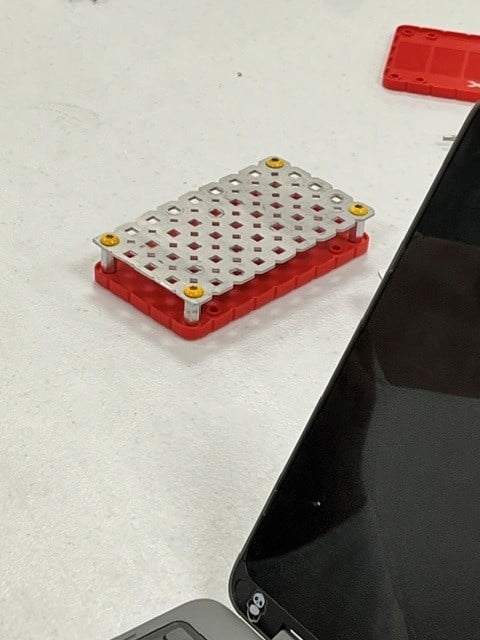
تم الرد بواسطة committee
<R4b> requires license plates to be "securely attached to the Robot." The mounting method shown in your photos fails to meet that requirement. The red-border box under <R4> provides the following guidance for securely mounting your license plates:
When a license plate is mounted to the Robot, only human influence should be able to remove the plate. The mounting should be secure enough to withstand any and all interactions between the Robot and other things on the Field. Using rubber bands or other flexible mounting methods to mount license plates should not be considered secure, and should not pass inspection. Using screws and nuts/standoffs to mount plates is the best way to meet the requirements for securely mounted license plates.
Additionally, doubling up on license plates as shown in your photos would be a violation of <R4e>, which prohibits the use of additional license plates beyond the two required by <R4a>. Using metal in place of the second license plates on each side would avoid violating <R4e>, but merely sliding this over standoffs is still going to violate <R4b> for not being securely attached to the Robot.
2566: R4 & SG2 Robot Status during size measurement for inspection
For this question there are two parts:
Part 1
My question relates to the initial inspection of the robot starting size: <R4> Robots must fit within an 18” x 18” x 18” volume.
Compliance with this rule must be checked using the official VEX Robotics On-Field Robot Expansion Sizing Tool. Any restraints used to maintain starting size (i.e., zip ties, rubber bands, etc.) must remain attached to the Robot for the duration of the Match, per <G6>. For the purposes of this rule, it can be assumed that Robots will be inspected and begin each Match on a flat standard foam field tile. (https://events.vex.com/storage/game_manual/VEX_V5_Robotics_Competition_2024-2025_High_Stakes/rules/R4.html
At a recent tournament, a few robots came to inspection when turned off they would not fit in the 18X18X18 starting required volume. However, if the team turned the robot on and activate the program the robot would pull itself into the accurate starting volume. At the beginning of a match TM does not allow the motors to activate, the robot is in a rested position and not longer meets the starting volume. Due to this the inspection team was not passing the robot. The coach addressed concerns that the rule does not say that the robot must be either on or off.
When robots are presented for inspection for the 18X18X18 should they be off or out of program to mirror the beginning of a match when connected to tournament manager?
Part 2:
<SG2> Horizontal expansion is limited. Once the Match begins, Robots may only expand beyond their starting size and configuration within the following criteria: a. Robots may never exceed an overall footprint of 24” x 18”. For reference, 24” is roughly the width of one foam field tile.
At the same tournament, teams were coming to the inspection table to mearsure the 24" x 18". The robot would rotate outside of the 24 inches, teams would indicate that the motors were used to prevent this from happening either by using a rotational sensor or the internal motor controllers. The inspection team indicated that the rule states in appendix a. that the robot is to "never" exceed the 24" x 18". The explanation was that if the motor disconnected during the match they would have no way to keep the robot in the required expansion limit.
When robots are presented for inspection for the 24"x 18" can the students use the program to ensure the robot does not exceed the expansion limit of 24 inches, or should it have the ability to stay within the 24 inches without the use of a sensor?
تم الرد بواسطة committee
When robots are presented for inspection for the 18X18X18 should they be off or out of program to mirror the beginning of a match when connected to tournament manager?
Either is fine, but if the Robot is inspected while powered on, it must be able to stay "in size" while in a disabled state, similar to how the Robot must maintain starting size to begin a Match in accordance with rule <G5>.
When robots are presented for inspection for the 24"x 18" can the students use the program to ensure the robot does not exceed the expansion limit of 24 inches, or should it have the ability to stay within the 24 inches without the use of a sensor?
Using code and sensors to prevent the Robot from exceeding the maximum expansion size is a legal strategy. As with any other means of keeping the Robot in size, any expansion beyond the legal limits will be considered a Violation.
2447: Removal or Modification of Subsystem 3 - Inspection Clarification
Our team has a removable intake extension used for Driver Skills and Autonomous. At a recent competition, they were informed that <R4.d.i> requires re-inspection of the robot every time the intake extension is added or removed.
Q&A 2207: Modification and swapping of robot subsystems (1) states: "There is no requirement that a Robot be reinspected each time a Robot is revised to match a pre-inspected configuration."
Can you please clarify? Is there a disconnect between <R4> and Q&A 2207 or should <R4> be interpreted that re-inspection is only required if the robot is brought to the field in an a) uninspected and/or b) noncompliant configuration?
تم الرد بواسطة committee
Rule <R4> states that:
Teams using more than one possible Robot configuration at the beginning of Matches must tell the Inspector(s) and have the Robot inspected in all configurations. Rule R3c will apply if a Robot is placed in an uninspected configuration (i.e., will not be permitted to play until re-inspected, but will not be considered a “no-show”).
Per Q&A 2207:
As described in clause B of R3, "All possible functional Robot configurations must be inspected before being used in competition. This especially pertains to modular or swappable mechanisms (per R1) and Match starting configurations/sizes (per R4)." There is no requirement that a Robot be reinspected each time a Robot is revised to match a pre-inspected configuration.
If a Robot configuration has been pre-inspected and has not been modified, it does not need to be re-inspected.
should R4 be interpreted that re-inspection is only required if the robot is brought to the field in an a) uninspected and/or b) noncompliant configuration?
Yes
1957: Fitting in the sizing tool
When using the sizing tool for robot inspection, if the robot width is exactly at 11" and fits flush against the sides of the sizing tool without bulging the sizing tool or any pieces of the robot, is that considered legal? Does a piece of paper need to fit between the robot and sizing tool to show it fits freely?
تم الرد بواسطة committee
Because the VEX IQ Robot sizing tool is built with IQ beams, the tool is "on pitch," and dimensions will be nearly exact. If a robot is designed to be on pitch and exactly 11" wide, it might slightly glide against the beams of the tool, which is fine. However, if there is any resistance, bowing, bending, etc. of the tool, the Robot does not meet the size requirements in rules <G5> and <R4>.
1865: Robot sizing
I had something come up at the last event I was head ref at. A robot passed inspection was in compliance with the 18x18x18 size requirement. later during qualifying round the opposing alliance challenged the robots size. on field the robot was "snug" in the sizing tool. my decision was to let it compete but issues a warning to the team. The question is if a robot passes inspection but fails size at a later time should they be disqualified and not allowed to compete until it passes re-spection?
تم الرد بواسطة committee
This scenario is a combination of a few rules. The short answer is that they should not be allowed to compete until the sizing violation has been remedied. If the violation was caught prior to the start of a Match, it should not be considered a Disqualification. If the violation was caught immediately after a Match (i.e. before the Team had left the field), they should receive a Disqualification for that Match.
Per <G5>:
Violation Notes: Any Violation of this rule will result in the Robot being removed from the field prior to the start of the Match, and rules <R3d> and <T5> will apply until the situation is corrected.
Per clauses C, D, and E of <R3>:
c. Teams may be requested to submit to random spot inspections by Head Referees. Refusal to submit will result in Disqualification.
i. If a Robot is determined to be in Violation of a Robot rule before a Match begins, the Robot will be removed from the field. A Drive Team Member may remain at the field so that the Team does not get assessed a “no-show” (per <T5>)
d. Robots which have not passed inspection (i.e., that may be in Violation of one or more Robot rules) will not be permitted to play in any Matches until they have done so. <T5> will apply to any Matches that occur until the Robot has passed inspection.
e. If a Robot has passed inspection, but is later confirmed to be in Violation of a Robot rule during or immediately following a Match by a Head Referee, they will be Disqualified from that Match. This is the only Match that will be affected; any prior Matches that have already been completed will not be revisited. <R3d> will apply until the Violation is remedied and the Team is re-inspected.
1827: R4 Robot inspection configuration
(https://events.vex.com/storage/game_manual/VIQRC_2023-2024_Full_Volume/rules/R4.html)[<R4>]
R4.c.I : Robot starting configuration required to be inspected, if robot has more than one configuration - does the word configuration refer to different parts / mechanisms (ie an extra claw) or to the configuration of a robot, itself (ie an extended claw)? Our specific question is that our claw could be retracted and fit in the required footprint of R4.b -- but if extended, would not fit. Thanks! Pete Miller
تم الرد بواسطة committee
R4.c.I : Robot starting configuration required to be inspected, if robot has more than one configuration - does the word configuration refer to different parts / mechanisms (ie an extra claw) or to the configuration of a robot, itself (ie an extended claw)?
These are both possible applications of the word "configuration".
Our specific question is that our claw could be retracted and fit in the required footprint of R4.b -- but if extended, would not fit.
<R4> and <G5> refer specifically to starting configurations. In your example, if the Robot is never intended to start the Match with the claw extended (i.e. never violates G5), then that configuration would not apply to R4.
However, bear in mind that <SG2> still applies during Matches. Compliance with both <R4> and <SG2> are usually checked alongside each other during inspection, but can technically be handled separately. In your example, we would recommend incorporating a "hard stop" or software limit into any extendable mechanism, to more clearly demonstrate to inspectors that the Robot is prepared to comply with <SG2> during Matches.
1784: Are cables considered for size & parking?
This has come up with my teams in previous years, but hasn't mattered much. With this year's supply zone and fully parking, it has now become an important question. When determining size restrictions of a robot, do loose cables count? Is it the same ruling when considering a breach of the parking zone? I see two possible solutions:
- Either they do not count for size and do not count for parking (ie a cable over the zone is not a partial park, or a cable outside the zone with the rest of the robot inside is still a full park)
- or they do count for size (cables must be within starting size configuration) and do count for parking (ie a cable over the zone is a partial park and a cable outside the zone with the rest of the robot inside is not a full park)
Obviously I can teach kids about proper cable management, but they resist without explicit rulings. There is a note in R1 about subsystems 2&3 being a part of the robot, but I am still unclear if that includes cables as it specifies motors but not cables.
Thank you!
تم الرد بواسطة committee
When determining size restrictions of a robot, do loose cables count? Is it the same ruling when considering a breach of the parking zone?
Yes, loose cables count as part of the Robot when determining whether or not the Robot is within the size limits, and when determining whether a Robot is Partially or Fully Parked. Everything attached to the Robot counts as part of the Robot (e.g., cables, non-functional decorations, Robot Brain, shafts, etc.). If a cable or other part comes loose but remains connected to the Robot it still counts toward the Robot's size and the horizonal expansion limits in rule <SG2>. In most cases when a loose or dragging part is not being used to score points, this type of SG2 Violation would be a Minor Violation and a warning (unless repeated).
1705: Interaction with Green Cube when Placing Robot in Starting Position
I helped with a tournament this weekend and had some questions about a way a team was placing their robot in the starting position.
This robot is within the 20x11x15 inch starting volume. It is touching the back wall and not touching any game elements. I believe this is a legal starting position.
Is it legal for the driver to lift the green block up, place the robot, and then return the green block to its position prior to the start of the match, as long as they put it within legal tolerances and not touching the robot?
If it is not considered legal for the student to pick up the green block and replace it, would it be legal to place this robot in this starting position if the student is able to maneuver it in such a way that it doesn't touch or disturb the placement of the green block, even though the block could be considered to be "inside" the robot?


تم الرد بواسطة committee
Drivers may adjust the position of a green Block that will begin the Match within their Robot's legal Robot starting position.
Per clause A of rule <T6>, Teams must place their Robots on the field promptly and be ready to play. This would include any adjustments made to the position of a green Block.
As described in the VIQRC Referee Guide in the REC Library, the Head Referee should check that all game objects--including any green Blocks that are adjusted by Drivers--are in the correct places before the Match begins and that all Robots are in legal starting positions.
1625: <R4> Using External Factors to Stay In Size
<R4> Robots must fit within an 18” x 18” x 18” volume.
a. Compliance with this rule must be checked using the official VEX Robotics On-Field Robot Expansion Sizing Tool: https://www.vexrobotics.com/276-5942.html. b. Any restraints used to maintain starting size (i.e., zip ties, rubber bands, etc.) must remain attached to the Robot for the duration of the Match, per <G6>. c. For the purposes of this rule, it can be assumed that Robots will be inspected and begin each Match on a flat standard foam field tile.
- Can a Robot use a Preload to stay in size?
- Can a Robot use a field perimeter wall to stay in size?
تم الرد بواسطة committee
Thank you for your question. As described in rule <G5>,
Using Field Elements, such as the field perimeter wall, to maintain starting size is only acceptable if the Robot would still satisfy the constraints of <R4> and pass inspection without the Field Elements.
Rule <G5> will be expanded in the next game manual update to include Preloads in this requirement.
1568: Robot head orientation in starting configuration
There are no specific starting positions, as long as the above criteria are met. How about robot head orientation in starting configuration. Is it ok as the following picture shows.

تم الرد بواسطة committee
Provided the robot meets all of the criteria established in <SG1>, including contact with the field perimeter, this would be a legal starting configuration.
1516: Can robots start away from the field perimeter?
Regarding:
a. Only be contacting the Floor and/or the Field Perimeter.
and
Contacting the inside and/or top face of the Field Perimeter wall
The ambiguity around "and/or" is our point of inquiry (dictionary: https://www.merriam-webster.com/dictionary/and%2For):
Based on the definition and our understanding of "and/or", Rule R4 appears to allow contacting the floor without contacting the perimeter ("or"). Surely the intended conjunction is simply "and" here? Something like:
Be contacting the Floor and the Field Perimeter inside wall or top face.
Rule SG1 seems to be clearer: Must contact the inside or top face. A bot that only touches the top of the wall is not really materially different than one that only touches the inside wall. Nevertheless, clarification in the Q&A would be appreciated: it's OK for a bot to only touch the floor + top of wall but not the inside of the wall?
Is it possible that the intended phrasing is something more like:
Contacting the inside face of the Field Perimeter wall. Additional contact with the top face of the Field Perimeter wall is permitted, but not required.
Thank you for any clarification. Sorry, we obviously have some budding lawyers over here.
تم الرد بواسطة committee
Thank you for your question. Clause A of rule <R4> will be revised to read, "Only be contacting the Floor and the Field Perimeter" in the next game manual update.
1295: Field Displays <S2> <S1> <R4>
<SC2> states:
If a Robot comes in contact with anything outside of the field during the Endgame period or due to an early expansion, including the floor or the outside face of the Field Perimeter, it will automatically receive a Disqualification for that Match.
- If a Field Display is in use, is it considered outside the field perimeter, such that a team automatically receives a Disqualification if it contacts the field display during Endgame or due to an early expansion?
<S1>and <R4> protect field elements, including Field Displays. <Q&A1263> Asks if pneumatic reservior nuts are legal for use as a projectile in an Endgame expansion system. The response indicates latitude for inspectors and Head Referees to determine the safety of an expansion system:
The type of Endgame mechanism you describe is potentially legal. Teams, Inspectors, and Head Referees must apply judgment to determine whether any specific mechanism is unsafe as described in rule <R4>, and in particular <R4d>
- Is potential damage to a Field Display by an expansion system (such as use of pneumatic reservior nuts as projectiles) a valid reason to fail a team at inspection based on R4a?
تم الرد بواسطة committee
- If a Field Display is in use, is it considered outside the field perimeter, such that a team automatically receives a Disqualification if it contacts the field display during Endgame or due to an early expansion?
Yes. The Field Display is considered to be outside the Field Perimeter, and contact with the Field Display by a Robot during during Endgame or due to an early expansion is a violation of <S2> that will result in an automatic Disqualification.
- Is potential damage to a Field Display by an expansion system (such as use of pneumatic reservior nuts as projectiles) a valid reason to fail a team at inspection based on R4a?
It is possible to use pneumatic reservoir nuts as part of a safe and legal expansion mechanism. Inspectors and Head Referees must consider the entire mechanism when determining whether a specific expansion mechanism should be allowed. In the right (or wrong) circumstances, nearly any Robot on the Field could cause damage to a Field Display in nearly any VRC season. This possibility is not, by itself, a valid reason to fail a Robot at inspection.