Klausimai ir atsakymai
VEX IQ Robotics Competition 2026-2027: Level Up
Pažymėta: G3
Welcome to the official VEX IQ Robotics Competition Question & Answer system, where all registered teams have the opportunity to ask for official rules interpretations and clarifications. This Q&A system is the only source for official VEX IQ rules clarifications, and the clarifications made here from the Game Design Committee (GDC) are considered as official and binding as the written Game Manual itself.
Please review the Q&A Usage Guidelines before posting. This system is only intended for specific VEX IQ game rules questions.
- For event, registration, or other competition support questions, please contact your Program Support Manager.
- For VEX technical support, contact [email protected] or [email protected].
- For game questions, suggestions, or concerns outside of specific and official rules questions, contact [email protected]
Indeksas
- Forced into penalty with Disablement during Auton
- Manual Update Definition of Scored Contradiction
- V5 and Cortex robot inspection checklist differences
- Use of Marker on Bean Bags
- Legal Part- Hexbug Shock Absorber
- Legality of FLEX Wheels now that they are no longer appear on VEX Robotics product site
- Implementation of a consistent escalation of repeated minor violations to major violations
- When are minor Game Manual updates effective?
- Clarification of Rule R9 - Keep the power button accessible
- Long Goal Control Zone Tape Clarifications
- Returning Blocks to a Drive Team Member Clarifications
- Interpretation of <G4b> as it relates to permanent team member move for state championship for non-strategic reasons outside of students’ control
- Strategic use of R3
- Legality of "coaching" from the stands/audience by team members and adults
- Is driver allowed to have/use electronic timer.
- <G3><S2> Endgame Launcher Firing During Match Scoring and Landing Outside the Field
- Disc over the fence <removal vs disqualification>
- Knocking Discs out of High Goal by Hitting Field Perimeter
- Low Goal Barrier Trapping - Q and A 1265 Clarification
969: Forced into penalty with Disablement during Auton
In the autonomous period, if two robots grab a goal and the Red robot pulls the Blue robot across the alliance line.
- is this a violation for the Blue robot?
Rules say that a robot may not be forced into a penalty.
But what if the Blue robot still in auton then Disables the Red robot? Is there any penalty by either robot?
Atsakė committee
Please review the Q&A Usage Guidelines before posting, specifically point 3, "Quote the applicable rule from the latest version of the manual in your question".
In this case, the applicable rule is SG5, quoted below, with a portion bolded for emphasis.
<SG5> Enter the Neutral Zone during Autonomous at your own risk. Any Robot who engages with the Neutral Zone during the Autonomous Period should be aware that opponent Robots may also choose to do the same. Per <G11> and <G12>, Teams are responsible for the actions of their Robots at all times.
a. For the purposes of this rule, “engages with” means any combination of:
i. Contacting foam tiles within the Neutral Zone
ii. Contacting Neutral Mobile Goals
iii. Contacting Rings that begin the Match on the double white tape line in the center of the Neutral Zone
b. If opposing Robots contact one another while both engaging with the Neutral Zone, and a possible <G12> violation results (i.e. damage, Entanglement, or tipping over), then a judgment call will be made by the Head Referee within the context of <G12> just as it would if the interaction had occurred during the Driver Controlled Period.
c. If opposing Robots contact one another while both engaging with the Neutral Zone, **and an incidental violation of <SG4> occurs, **no penalty will be assessed on either Alliance.
d. <G15> does not apply during the Autonomous Period.
e. Intentional, strategic, repeated, or egregious offenses of points “b” or “c” may still be deemed a violation of <SG4>, <G12>, <G13>, <G14>, <G1>, and / or <S1> at the Head Referee’s discretion.
As well as the following portion of the "red box" underneath SG5:
The Neutral Zone is intended to be a zone that Robots from both Alliances can utilize during the Autonomous Period. This will inevitably result in Robot-on-Robot interactions, both incidental and intentional. The overarching intent of <SG5> is for the vast majority of these interactions to result in no rule violations and / or penalties for either Alliance, just as no rules violations occur in 99% of Driver Controlled interactions.
So, with those quotes in mind...
if two robots grab a goal and the Red robot pulls the Blue robot across the alliance line. is this a violation for the Blue robot?
This sounds like an incidental violation of SG4. Therefore, point "c" would apply, and no penalty would be assessed on either Alliance.
But what if the Blue robot still in auton then Disables the Red robot? Is there any penalty by either robot?
This sounds like a possible violation of G12. Therefore, point "b" would apply, and the Head Referee will make a judgment call within the context of G12 just as if the interaction had occurred during the Driver Controlled Period. In most cases, this would be considered "no violation".
As stated in G11, G12, and SG5, Teams are responsible for the actions of their Robot at all times. Robots who choose to engage with the Neutral Zone during the Autonomous Period should be aware that opponent Robots may also choose to do the same, and prepare for the risks associated with doing so.
878: Manual Update Definition of Scored Contradiction
Scoring Note 1 states:
Rings can be Scored in Mobile Goal Bases, or on Mobile Goal Branches. In order to be considered Scored in either position, a Ring must first meet the following prerequisite criteria:
• Not contacting a Robot of the same color Alliance for which the Rings would receive points
• Not contacting any Field Elements, such as gray foam field tiles, the Platform, or the field perimeter
• Not contacting any Rings which are not considered Scored (i.e. Rings which are contacting a Robot or a Field Element)|
Emphasis mine.
On page 18 of the game manual near the bottom Scoring figure 5 is shown, which depicts a stack of rings on a mobile goal that exceeds the height of the branch, resulting in the top few rings not being scored (I have attached this image to this Q&A)
 The caption for this figure reads:
Only the highlighted Rings would be considered Scored, as they are the only ones fully or partially encircling the Mobile Goal Branch.
From my understanding of Note 1 bullet point 3, none of the rings in Figure 5 should be considered scored, since the rings on top which are not considered scored are contacting the rings beneath them, causing a chain of not scored rings which results in all of the rings not being scored. A very similar situation is show in in Figure 3 and Figure 2 that demonstrates this concept. Despite this, Figure 5 states that the rings below the unscored rings are, in fact, scored, which seems to be a contradiction. Can the GDC please clarify if the green shaded rings in Figure 5 are not scored as the Note states they are not or if they are scored as the caption say they are? Thank you.
Atsakė committee
Thank you for bringing this to our attention.
The intent of the figure was primarily to demonstrate what was meant by "encircling a Mobile Goal Branch", by depicting a scenario where Rings did not meet this definition.
Your interpretation of Note 1 is correct; if this situation were to actually occur in a Match, none of the Rings would receive points, as they are all transitively contacting the top un-shaded Rings. We will be sure to update this caption in a future Game Manual update to make this distinction more clear.
71: V5 and Cortex robot inspection checklist differences
In the new V5 Robot Inspection checklist it specifically calls out <R8g> but the Cortex inspection checklist does not. Should it be considered that Cortex robots can not violate <R8g>
In the V5 checklist, it specifies that the sensor has been calibrated on competition fields - does this imply teams calibrate before inspect? on practice fields? home fields? before each match? If before a match, how much time should be allowed for teams to calibrate? This item does not have a rule associated with it. If we are to consider that the variance of lighting conditions is significant between fields, then it suggests this should be before each match and a <G> rule should be associated with it. V5 is all new to us, so <G2> is not there yet :)
In V5 check list it is implied that teams are allowed one controller - yet for Cortex two... <R15> does not make distinction between the two systems with regards to number of controllers.
I would recommend that the V5 inspection checklist be sorted in numerical order consistent with cortex, and that a single document (two sided) be provided so that the inspectors only need to pull one sheet and fill out accord to system.
thanks for the getting out the V5 checklist: https://www.roboticseducation.org/documents/2018/09/vrc-v5-brain-robot-inspection-checklist.pdf
Atsakė committee
It would be impossible for teams to calibrate robots on the field before each match. Event Partners should take lighting conditions into consideration when planning for an event. The added statement “If Vision Sensor is used, it has been calibrated & tested on competition fields or team accepts responsibility for doing so” reminds teams that it is their responsibility to calibrate their robot matches begin so that they come to their first match prepared.
The V5 Robot Inspection Checklist has been updated to include up to 2 V5 Controllers, and rule <R8g> has been added to the Cortex Checklist. Keep in mind, all rules from the Game Manual still apply regardless if they are called out on the Robot Inspection Checklists. Please check www.RoboticsEducation.org for the latest versions.
3317: Use of Marker on Bean Bags
<G3> Q and A 3263 had a question regarding an adaptation for disability. We are about to attend a large event where multiple teams are loaning their fields to the Event Partner, including us. For accountability, would it be permissible for our bean bags to be marked with a permanent marker in order to make sure we leave the event with our equipment? We are loaning out 3 fields and are considering marking our bean bags "RS" for our school name.
Atsakė committee
<T6> lists examples of permissible modifications at competition events, which includes "small markings on Field Elements and Scoring Objects to identify ownership."
A small "RS" marking on your school's Bean Bags would be allowed in this case. We ask that you please limit this to a maximum of one marking per side of the Bean Bag.
3314: Legal Part- Hexbug Shock Absorber
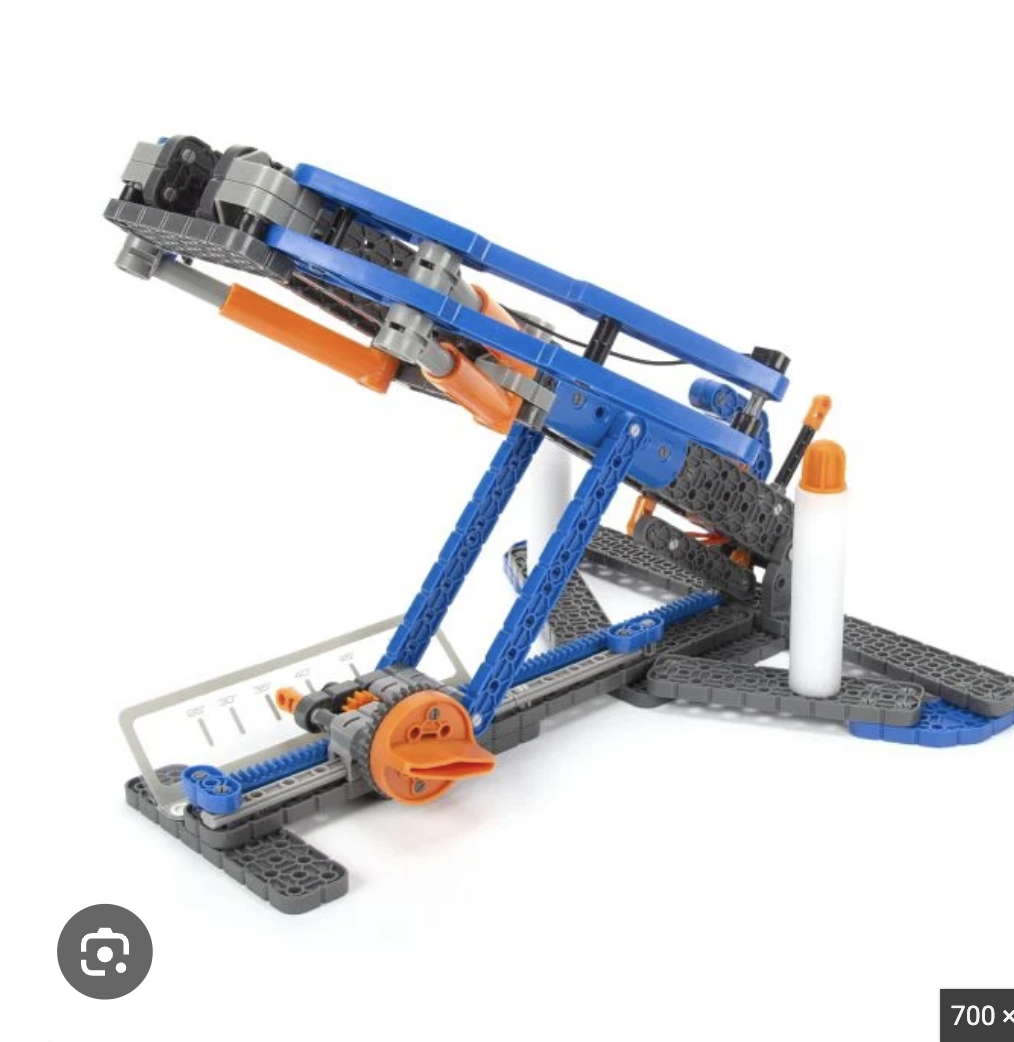
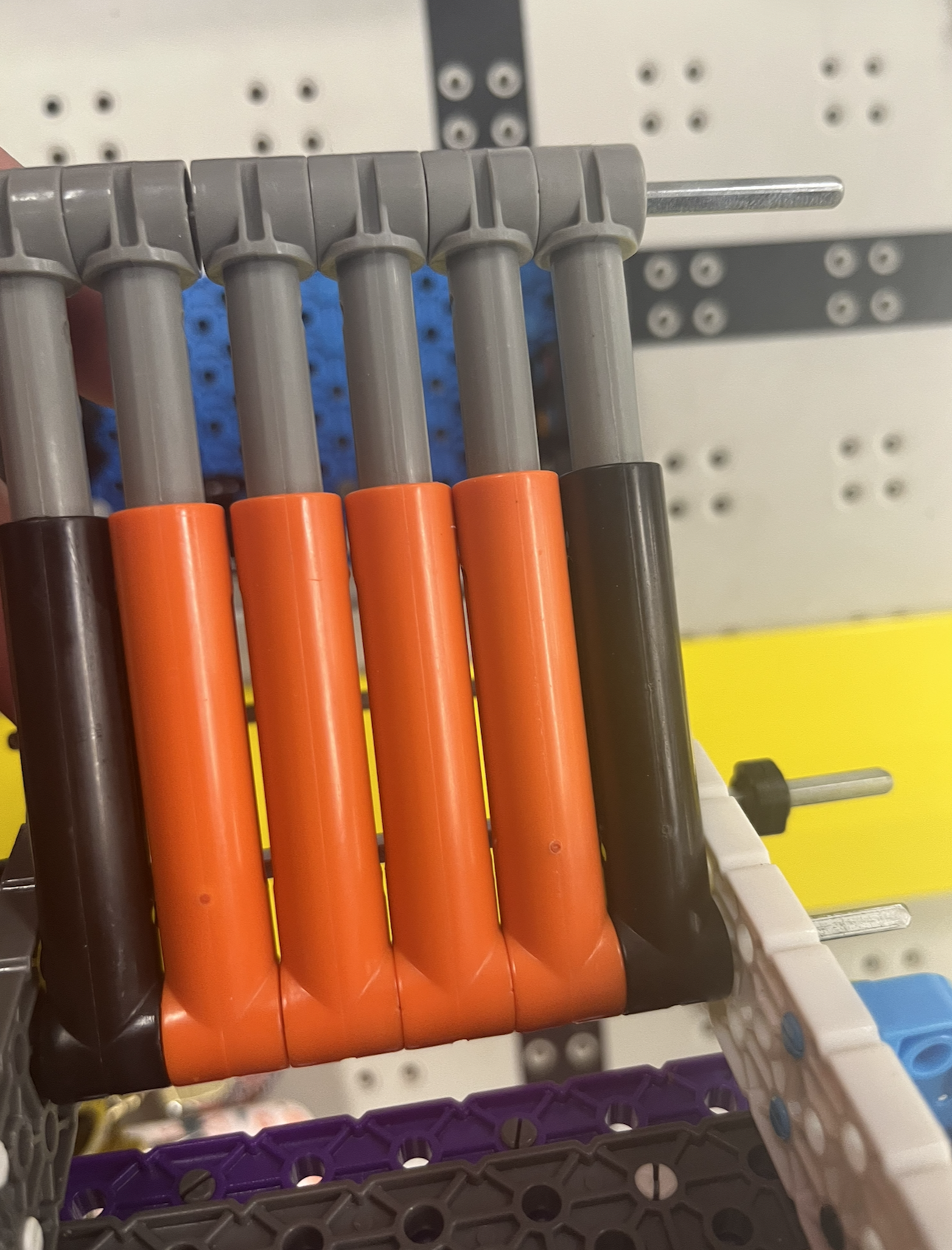
Our students are wanting to use the Hexbug orange shock absorber. It is not listed in the legal or illegal parts but other VEX/HEX shock absorbers are shown as being legal. We know there is a color difference and that color might not matter, but In their testing they believe this orange shock absorber has more strength than the strong black version that is listed in the VEX legal parts and might not be the same part as seen in the legal part appendix. There is no part number listed on the shock absorber to list here in the Q and A or to match to the legal parts. Is this hexbug Shock absorber legal?
We have attached photos of part and what it was use for in hexbug.
Atsakė committee
The shock absorbers from the VEX Robotics by HEXBUG product line use the same parts and share the same part number (228-2500-1480) as the 2x Pitch Shock Absorber (Strong), which is listed as a legal part in the VEX IQ Robotics Competition Legal & Illegal Parts List. Therefore, these parts are legal for use on your competition Robot.
3023: Legality of FLEX Wheels now that they are no longer appear on VEX Robotics product site
<R17> Apparently VEX Robotics has purged FLEX Wheels from their website. As written, in the Game Manual, the parts must appear in the VEX Robotics product website or on the legacy/discontinued parts list. FLEX Wheels do not exist in either location, and the link in the Game Manual to VEX Pro line goes to "404 page not found".
Can the GDC make this a G3 situation and allow for FLEX Wheels this coming competition week? Or should Head Referees deem them an illegal for V5 competition?
Atsakė committee
Flex Wheels by VEX Robotics remain legal in the VEX V5 Robotics Competition. This includes all previously legal Flex Wheels (1.625", 2", 3" and 4") in all durometers (30A, 45A, 60A), as well as VersaHex Adaptors and Versahubs.
The GDC has no further information on when Flex Wheels will return to the VEX Website for sale. Please contact the Sales Department at VEX Robotics for more information and/or inquiries about purchasing Flex Wheels.
Additionally, we (the GDC) have determined that using the VEX Robotics website to determine legality of parts in the VEX V5 Robotics Competition is no longer ideal, and have created a new supplementary document to assist in determining legality of parts in the competition. This living document will list all of the parts that are legal in the VEX V5 Robotics Competition. It will live as a Google Sheets document, making updates easy and immediate. Because updates are immediate, the document should always be considered up-to-date and binding.
We will update rule <R17> to reference the new V5RC Legal Parts List in the next game manual update, along with any other rules as needed.
The VEX V5 Robotics Competition Legal Parts List is available at the following link: https://link.vex.com/V5-Competition-Legal-Parts.
This document is brand new and, although we have reviewed it for accuracy before release, it may require ongoing updates to ensure all legal parts have been captured in the document. If you notice any omissions or errors while reviewing and reading this document, please contact us at [email protected] to share your concerns. All parts that were previously legal through listings on the VEX Robotics website are still legal for use, and should be included in this new document.
We have chosen to release the V5RC Legal Parts List now to ensure Teams are able to complete Robot inspection and compete with their current Robots and parts with minimal stress. We ask for your patience while we work to improve this new document, and we appreciate your help in identifying necessary corrections and additions.
3014: Implementation of a consistent escalation of repeated minor violations to major violations
Note: This question was revised by the GDC for clarity and readability.
Is the following permissible?
It is announced at the driver's meeting that the 4th time a minor violation of a specific rule is recorded in the match anomaly log for a team, the 4th and all further violations of the same specific rule will be escalated to major violations. 4 violations of a specific rule, keep in mind the minimum number of matches for an official event is 6 so 4 is more than half of the minimum number of required matches, is explicitly stated at the drivers meeting to be the threshold value for the number of occurrences that will lead to a major violation.
Per <T1b>, a team has had 3 matches at a tournament where they have been explicitly told about their minor violations of <GG8> each match that their license plates have fallen off. At the conclusion of the 4th match at a tournament where a license plate has fallen off, a 4th minor violation of <GG8>, the team is disqualified from this match.
Atsakė committee
As described in the definition of Violation in the game manual, "Multiple Minor Violations within a Match or tournament may escalate to a Major Violation at the Head Referee’s discretion or as specified in a rule."
It would be reasonable for a Head Referee to notify Teams that their 4th Minor Violation of a specific rule without specific guidance (and any subsequent Violations of that rule) would become a Major Violation and Disqualification for the Match. This guidance should be provided to all Teams at the event, ideally during the event meeting. However, this guidance might not be appropriate at all times during a season, or as blanket guidance for all rules and events.
2968: When are minor Game Manual updates effective?
According to the Game Manual's Update section, the updates are effective 1 week after the release date.
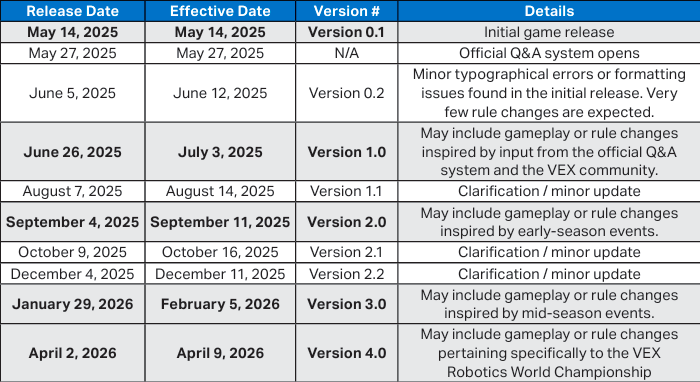 However, several of the Q&A answers state that "This (answer) is effective immediately" (or similar verbiage). How are we to know which Q&As effective and which are not, especially after a Game Manual update.
Atsakė committee
All Q&As on RobotEvents.com are effective immediately, as stated in the Updates section of the game manual.
2796: Clarification of Rule R9 - Keep the power button accessible
<R9> Rule <R9> states, in part, "The on/off button on the VEX IQ Robot Brain must be accessible without moving or lifting the Robot." The comment block goes on to further explain, in part, "In the event that a Robot needs to be quickly powered off - whether due to a malfunction, entanglement, or other safety concern - it is crucial that the power button remains easily accessible." Does "easily accessible" mean that the robot brain must be positioned in such a manner that the power button is not obstructed by any other part of the robot?
<G3> states to use common sense when applying the rules. What may make sense to one referee or inspector may not make sense to another.
Atsakė committee
Thanks for your question, Team 93558Z! We'll do our best to clarify the intent of that rule, but if you'd like to discuss it further you're welcome to email us at [email protected].
Does "easily accessible" mean that the robot brain must be positioned in such a manner that the power button is not obstructed by any other part of the robot?
The emphasis of rule <R9> is safety, as described in its blue box. The power button should be easily, quickly, and safely accessible if the Robot needs to be powered off during a Match. If a Head Referee could easily reach past an obstruction and turn off the Robot during a Match, it's probably not an issue. If a part needs to be removed for the Head Referee to reach the button, or the Robot has to be flipped over, the Robot doesn't meet the requirements of this rule.
We know there's some gray area in between those examples, and that's where <G3> comes in. Unfortunately, we're unable to provide blanket guidance that will apply to all Robots and designs, and the ultimate decision about whether or not a specific Robot meets the requirements of <R9> (or any other rule, for that matter) lies in the hands of the Robot inspectors and Head Referees at the event.
2789: Long Goal Control Zone Tape Clarifications
<T5a> Field Element tolerances may vary from nominal by up to ±1.0”.
On long goals for push back, tape is applied manually to define the control zone and may be applied onto goals by young and inexperienced volunteers like children. When taping the long goal control zone, I could see someone starting in the correct spot on the top of the goal (when fully assembled) but wrapping the tape around the goal in a way it slants away and back to the initial correct spot. In this plausible scenario, the long goal control zone would not match figure CZ-1 in Game-Specific Definitions. This brings up the first question,
- Does the entire tape line define the planes to the long goal control zone (such that the control zone would not be confined to two vertical projections perpendicular to the field) or does just the outermost, correctly-aligned tape at the top of the long goal (the corner of the goal in this example where the volunteer started to apply tape) define the projections to the long goal control zone?
<GG5> Match replays are allowed, but rare. a. Match Affecting “Field fault” issues. i. Field Elements starting in incorrect positions, and out of the allowed tolerances (see <T5><T5>).
<G3> Use common sense. When reading and applying the various rules in this document, please remember that common sense always applies in the VEX V5 Robotics Competition.
If the first question is the first answer and the applied tape for the long goal control zones appears off to those scoring the match (we are assuming the head referee(s) is here to keep calls like these consistent across an event), what should be done in the following,
-
The tape is with the 1" tolerance but is substantially offset (such as 3/4" offset, the entire width of the white tape itself) such that it has changed the state of a block being within the long goal control zone. The tape as is would not give benefit of the doubt the block could be in either state, it is well within one of the states inside or outside the control zone. The tape as it is defined in CZ-1 would give benefit of the doubt and decrease the certainty of calling the block in one state, the tape is not set for the referee to give benefit of the doubt for where the tape should be. The situation could also be flipped such that an unclear call would become clear when utilizing CZ-1's tape lines. Should the block be scored as is defined by the tape due to <GG5> or can <G3> be applied in egregious instances of tape technically within tolerance?
-
Take the same situation as 2 above but the tape is outside the 1" tolerance. Should the block be scored as is since the field has been that way all day, can <G3> be applied in verified instances of tape outside tolerance, or is a match re-play after fixing the field long goal tape lines required, not allowed, as outlined in <GG5>?
-
Does situation 2 or situation 3 apply differently if the scoring decision in question is match affecting?
Atsakė committee
Hi, Karson, and thanks for these questions!
We'll start by saying that the next game manual update will include an additional clause for rule <T5> that specifies the tolerance for those tape lines is +/- 0.25". This change is effective immediately.
When placing those tape lines, care should be taken to ensure that they align with the edge of the closed portion of the Goal (and repositioned as needed).
To address your specific scenarios:
- If there is slight variance in tape alignment around a Goal, Head Referees should use the edges of the tape lines on the top surface of the Goal as a "tiebreaker."
- Same answer as #1.
- If (during or immediately following a Match) the Head Referee determines that a tape line is out of tolerance, and the incorrect tape position is determined to be Match Affecting, that Match should be replayed after the tape lines are repositioned to be within tolerance.
- If the misaligned tape line did not affect the outcome of the Match, no replay is needed.
2788: Returning Blocks to a Drive Team Member Clarifications
<SG4> Keep Blocks in the Field. Teams may not remove Blocks from the Field. A Block that leaves the field during Match play, intentionally or unintentionally, will be given to a Drive Team Member from the same color Alliance as the Block...
Using stored event items from Over Under, many EPs will likely use bins to store match load Blocks this year. In regard to <SG4> specifying a Drive Team Member will receive a block that has left the field, I have the following questions,
-
Can the Block be placed or tossed into a bin in a manner that is not reckless instead of directly handing the Block to a student?
-
If yes to question 1, must scorekeepers and other volunteers attempt to return Blocks in the same manner at an event or can they randomly (in terms of Drive Team Member expectations, they do not know what to expect) choose the manner they return Blocks?
-
If the first option is the answer to question 2, must scorekeepers be consistent with their method such that students have to be ready for whatever an event decides as their manner and cannot ask for the opposite or special instructions (if it is somehow possible to clarify beyond bin or hand) for receiving Blocks?
-
Applying <G3> and context of the full match, can the delay or an inconsistent manner of receiving a Block that left the field ever be deemed score affecting?
-
Does question 4 apply differently based on which alliance caused if the Block(s) in question to leve the field?
-
If yes to question 4, is the score affecting threshold of a match 3 points (as <SG9>'s violation notes value one Block), 13 points (the maximum amount of points a scored Block and a controlled zone can accumulate to), or the next highest accumulated points total given the full context of the match?
Atsakė committee
As always, thanks for your questions, Karson! Here are our answers:
- Yes. We'll update the guidance in the game manual to require that Blocks be given to the Alliance matching the color of the Block, not necessarily handed to them.
- There is no requirement that Blocks be returned in a predictable way.
- N/A
- No. Volunteers should return Blocks as quickly as possible, but this time will vary between Events and Matches based on the full context of the Match and available volunteers.
- No.
- N/A
2604: Interpretation of <G4b> as it relates to permanent team member move for state championship for non-strategic reasons outside of students’ control
Hello, GDC. We have a V5RC team (5430B) that has qualified for and is competing in the 2025 Missouri V5RC High School State Championship this Saturday, 03/08/2025. Unfortunately, 4 members of the 7-member 5430B team cannot compete due to the SAT on the same day. The remaining 3 members of team 5430B would love for two members from another one of our teams (5430D, who did not qualify for state and who’s season is over) to move to team 5430B in support.
This member move seems to be supported by the last sentence in Game Manual section <G4b> on p. 28 that reads: “When a Team qualifies for a Championship event (e.g., States, Nationals, Worlds, etc.) the Students on the Team attending the Championship event are expected to be the same Students on the Team that was awarded the spot. Students can be added as support to the Team, but may not be added as Drive Team Members or Coders for the Team.”
Are we interpreting the Game Manual section <G4b> correctly in that members can be added to the 5430B team in support, providing the new/moving members are not Drive Team Members or Coders (last line of G4b, highlighted in yellow below) and would fulfill other roles (e.g. mechanic, strategy, scouting, etc.) AND would move from one team (5430D) for non-strategic reasons (e.g. due to SAT test negative impact on 5430B) outside of the team’s control <G4a> AND would remain on team 5430B for the remainder of the season <G4b.i.> and not move back to 5430D? The two members who we propose move are not switching teams to support multiple teams <G4.a.ii>.
We want to do only what upholds the spirit of the game, is supported by the REC, is in the best interest of students, and allows our event partner and coaches to use common sense <G3> when upholding the game rules.
Thank you for your consideration and support.
CD

Atsakė committee
Are we interpreting the Game Manual section G4b correctly in that members can be added to the 5430B team in support, providing the new/moving members are not Drive Team Members or Coders (last line of G4b, highlighted in yellow below) and would fulfill other roles (e.g. mechanic, strategy, scouting, etc.) AND would move from one team (5430D) for non-strategic reasons (e.g. due to SAT test negative impact on 5430B) outside of the team’s control G4a AND would remain on team 5430B for the remainder of the season G4b.i. and not move back to 5430D?
Yes.
2426: Strategic use of R3
<G1>, <G3>, <R3>, <T5>, <T6>, Code of Conduct
If a team notices a problem with another team’s robot, which would likely cause that team to fail a ‘spot inspection’, do they have an obligation to report that information in a timely manner? Or could they wait until it is strategically advantageous to do so?
Example: During qualification matches, Team A noticed that Team B’s robot brain placement probably should not have passed inspection. Fixing the problem would have taken considerable time. Rather than approaching Team B and letting them know so they could fix their robot proactively, or informing the Head Referee directly, Team A waited until they were about to face Team B in a semi-final elimination match before pointing out the problem to the Head Referee.
Should Team B be allowed to play their match since they’ve played through all the qualification matches and it’s at the Head Referee’s discretion whether to conduct spot inspections? Or should their robot be removed from the field per R3, T5 & T6. Has Team A violated G1, G3, or the Code of Conduct?
Atsakė committee
We believe that this scenario falls under rule <G1>, "Treat everyone with respect." If you see anyone breaking a rule at a Match Field, you should immediately bring it to the Head Referee's attention and let them handle it as they deem appropriate. If you see a Violation away from the Field, you should alert the Event Partner. Teams must use extreme caution when handling these situations, and should remember to remain respectful, civil, truthful, and professional. Once the matter has been reported to the Head Referee or the Event Partner, their decisions and ruling will be final as described in rules <T1> and <T4>.
If a Head Referee believes a Team is reporting potential Robot rule Violations strategically, maliciously, or speculatively, it should be treated as a <G1> Violation and immediately brought to the attention of the Event Partner who should then consult with the REC Foundation Regional Support Manager as described in the Violation Notes for <G1>.
If a Team's Robot is found to be in Violation of a Robot rule during an event, rule <R3> (specifically clauses C, D, & E) will apply.
In the specific case you describe, in which a Team believes another Team's Robot Brain is in an unsafe location, Head Referees must apply judgment to determine whether or not the reported Team should be allowed to continue without modifying the Robot.
242: Legality of "coaching" from the stands/audience by team members and adults
I have a question regarding the legality of students or adults calling out from the stands/audience to drivers during a match. By far the two most common examples I have seen of this are:
- Someone periodically calling out the remaining time in the match, particularly if the students on the drive team are unable to see a match timer.
- Someone calling out "Get the yellow hub" or "Go hang" near the end of the match.
I have never seen this done in a disrespectful way so assume for this question that nothing is being said in a derogatory or offensive manner.
I have been told "All Drive team members are in Drivers stations and are students. There are NO coaches - Thus the coaching from any location is illegal." and that teams could be disqualified because of this. The reasoning for this was based on their interpretation of the following from the game manual and Code of Conduct:
G1 In all aspects of the VEX IQ Challenge program, the Students make the decisions and do the work with adult mentorship. Code of Conduct: • Student-centered teams with limited adult assistance.
G3 When reading and applying the various rules in this document, please remember that common sense always applies in the VEX IQ Challenge.
Nothing in the above would apply to students "coaching." Also, "adult mentorship" and "limited adult assistance" could be intepreted to allow adult "coaching" during a match.
So, I have two specific questions.
- Are students in the stands/audience allowed to call out time or things like "Go hang"?
- Are adults in the stands/audience allowed to call out time or things like "Go hang"?
For completeness here are rules G1, G2, and G3 in their entirety.
G1 Treat everyone with respect. All Students and adults associated with a Team are expected to conduct themselves in a respectful and positive manner while participating in the VEX IQ Challenge. If Team members are disrespectful or uncivil to staff, volunteers, or fellow teams at an event, the team may be Disqualified from their current or upcoming Match. Judges may also consider team conduct and ethics when determining awards.
In all aspects of the VEX IQ Challenge program, the Students make the decisions and do the work with adult mentorship. The VEX community prides itself on being a positive learning environment where no one is bullied, harassed, or berated. Teams avoid placing unnecessary stress upon students and/or event volunteers; instead, challenging situations are viewed as teachable moments to model positive behaviors and good sportsmanship.
This rule exists alongside the REC Foundation Code of Conduct. Violation of the Code of Conduct can be considered a violation of <G1> and can result in Disqualification from a current Match, an upcoming Match, an entire event, or (in extreme cases) an entire competition season. The Code of Conduct can be found at http://link.roboticseducation.org/recf_codeofconduct.
G2 VEX IQ is a student-centered program. Adults may assist Students in urgent situations, but adults should never work on or program a Robot without Students on that Team being present and actively participating.
> Some amount of adult mentorship, teaching, and/or guidance is an expected and encouraged facet of the VEX IQ Challenge. No one is born an expert in robotics! However, obstacles should always be viewed as teaching opportunities, not tasks for an adult to solve without Students present and actively participating. > > When a mechanism falls off, it is… > …okay for an adult to help a Student investigate why it failed, so it can be improved. > …not okay for an adult to put the robot back together. > > When a team encounters a complex programming concept, it is…> > …okay for an adult to guide a Student through a flowchart to understand its logic. > …not okay for an adult to write a pre-made command for that Student to reference.
G3 Use common sense. When reading and applying the various rules in this document, please remember that common sense always applies in the VEX IQ Challenge.
Atsakė committee
There is no one-size-fits-all blanket answer for this topic. In general, infrequent comments from the stands in the spirit of cheering on the students are aligned with the student-centered policy of the Game Design Committee and the REC Foundation.
Cheering from the stands, especially for a key end-of-match moment, is an exciting part of the VEX IQ Challenge's intensity; there is no positive learning experience to be gained by penalizing Student Drivers for receiving encouragement from their excited fans.
Similarly, calling out the amount of time remaining in a Match is a common practice for many play-by-play announcers, and is even included in the relevant Referee Training video as a suggestion to help with the 30-second Driver switch.
However - frequent, direct, and specific coaching instructions ("turn left, now pick up the Hub, now turn right, now go score") would not be within the spirit of the various student-centered guidelines in the Game Manual, Code of Conduct, Judges Guide, etc.
1798: Is driver allowed to have/use electronic timer.
We noticed that at some (Skill) Events, the timer is located in such a way that it's not visible to the driver. So we got the idea for the second driver to have simple electronic countdown timer attached to the wrist. Similar to like people attach phones when jogging. 2nd driver starts it at the start, and than both drivers can see it and know the time left.
At one of the events we were told it's not allowed. But I can not find anything about that in the rules. Seems like if it's not allowed, than any hand watches should not be allowed, which is silly.
Atsakė committee
There is no rule that prohibits Drivers from using a timer during a Match. Per clause A of rule <G8>, if a cell phone or other communication device is used as a timer, it must have all communication features turned off (e.g., be in airplane mode). Note that the official Match timer will still be used to determine the end of the Match (clause A of <SC1>) and the timing of the Driver switch (<G11>) in cases where an unofficial timer is also present.
1451: <G3><S2> Endgame Launcher Firing During Match Scoring and Landing Outside the Field
This past weekend, there was an instance where a team did not fire their endgame, but while the match was being scored it fired and landed outside the field. I was already over at the next match as everything already "came to rest" and was ready to be scored. I went over to the field after my match ended and talked to the team about how their robot fires their endgame. Due to how they have their pneumatics hooked up, a loss in pressure can cause the launcher to fire. They did inform me that they had a slight pneumatic leak and that is what caused it to fire. I will note that my scorekeepers said that none of them touched the robot.
This could be one of two scenarios for rulings based on which of the two rules takes precedence: < G3 > or < S2 >.
< G3 > : If this rule takes precedence, then it should not be ruled a DQ per < S2 > as the team did not intend to fire the mechanism. < S2 > : If this rule takes precedence, then it should be ruled a DQ as they are "responsible for the actions of their robots at all times"
As the Head Referee, I ruled it as a DQ per < S2 > due to the reasoning above.
Can further clarification be provided on which of these two rules would take precedence so that we know for future events?
Thank you,
Cowboy Chris
Atsakė committee
We believe our response to Q&A 1436 answers your question. If you need more clarification, feel free to rephrase and resubmit.
1399: Disc over the fence <removal vs disqualification>
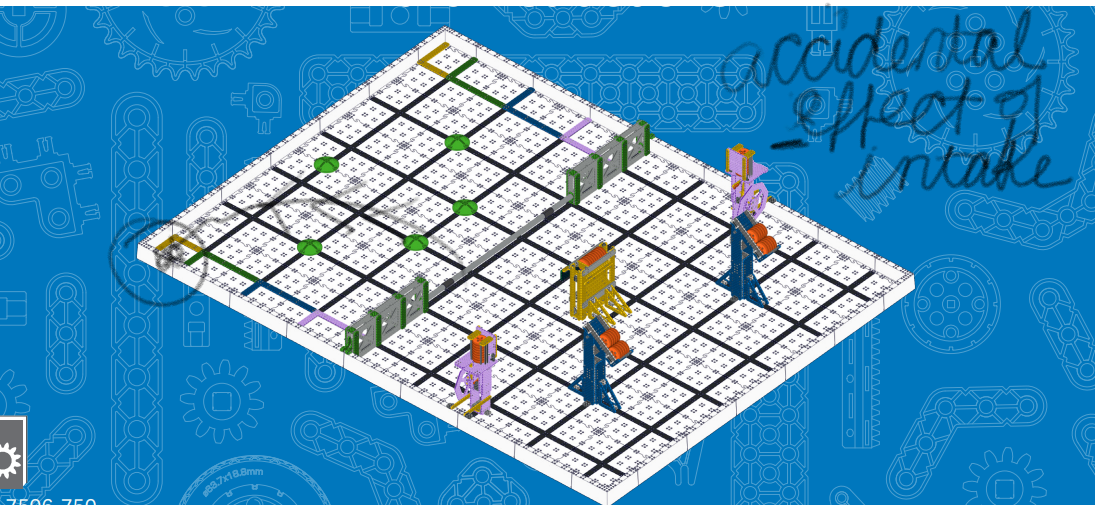
<G16> Discs go under the Fence, not over it. Discs may only be Scored in Goal Zone by passing them underneath the gray PVC pipe. Robot actions such as “dumping,” “placing,” or “throwing” Discs over the Fence are strictly prohibited, and will result in a Disqualification
I am requesting that this rule be revisited by what terms mean “dumping, placing and throwing” over the fence. This needs to be clarified, since one disc as a result of an accidental “bounce or ricochet” does not equal “dumping, placing or throwing” and to be immediately disqualified for an accident seems harsh indeed. If the singular disc landed outside of the field it would have resulted in a disc removal and no penalty.
We know in the robotic world there are those once in a lifetime freak accidents and that is when we should apply <common sense G3 > and should have been given the benefit of the doubt and spoke to them at the end of the match instead scaring them by announcing it during the match when they had no clue about the rule and did not understand what was going on.
Atsakė committee
As stated in the Q&A Usage Guidelines, the Q&A platform is intended to be a communication channel for questions such as "Is this interpretation of a rule legal?", not a discussion forum to post questions such as "I disagree with this rule, can it be changed?" For those comments, please use the official VEX Forum or email [email protected].
1321: Knocking Discs out of High Goal by Hitting Field Perimeter
Hello,
Q&A 1160 says it's illegal to use Discs to cause other Discs to fall out of the opponents High Goal.
As robots are getting better and better, goals are getting more and more full. We've noticed if a goal is filled in a precarious way, hitting the field perimeter causes the Discs to fall out of the High Goal. Is this a legal strategy?
Thank you for your time!
Atsakė committee
Thank you for your question! There is nothing in the Spin Up Game Manual that prohibits the strategy you've described. However, Teams should ensure that their Robot's actions do not cause damage to any Field Element as described in rule <S1>, including the Field Perimeter, Net, Net Assembly, and High Goal structure.
1302: Low Goal Barrier Trapping - Q and A 1265 Clarification
Q and A 1265 states:
A Robot that cannot cross the Barrier in that configuration has taken a calculated design risk, whether consciously or accidentally. Neither of your scenarios or images should be considered Trapping in Spin Up.
However, if a Robot's wheels are parallel to the Barrier, and an opposing Robot is restricting their movements by pushing them against the Barrier, that may be considered a Trap at the Head Referee's discretion based on the other actions of both Robots
G15 states:
A Robot may not Trap an opposing Robot for more than five seconds (0:05) during the Driver Controlled Period.
G3 states:
When reading and applying the rules in this document, please remember that common sense always applies in the VEX Robotics Competition.
-
How do holonomic drives (X drive, mecanum drive, Y drive, and H drive) count when determining parallel or perpendicular to the barrier?
-
How far should the wording calculated design risk be taken, and what differentiates the ruling in these scenarios?
a. A blue robot with a 4 motor drive robot is pinned with their wheels perpendicular to the field perimeter by a red robot with a 6 motor drive of the same speed. Is this trapping as the robot took the calculated design risk to not have as much torque?
b. A blue robot with a standard tank drive is pinned with their wheel parallel to the perimeter by a red robot. Is this trapping as the blue robot took the calculated design risk to not to be able to strafe?
c. A 17.5 inch wide blue robot is constrained to a small corner of the field by a red robot blocking their path out. The red robot leaves a gap of 17 inches. Is this trapping as the blue robot took the calculated design risk to have a wider robot?
d. A 17.5 inch tall blue robot is constrained to a small corner of the field by a red robot blocking their path out. There is a gap for the blue robot to escape, but the roller is in this gap. Is this trapping as the blue robot took the calculated design risk to no be short enough to fit under the roller?
-
What other design risks do teams need to consider that are not listed in the manual (nowhere in the manual does it list any advantage to be able to drive over the low goal)?
-
Given the fact that the low goal barriers are known to tear field tiles if hit hard or constantly pushed on, is a game strategy that involves trapping opposing robots against the barrier a violation of S1?
Atsakė committee
After reviewing match footage from multiple recent events, we have determined that our original response to this question shifted gameplay too far in the direction of defensive Robots. Effective immediately (Dec 13, 2022), holding an opponent against a Barrier such that they cannot escape will be considered Trapping as described in rule <G15>.