Q&A
VEX IQ Robotics Competition 2026-2027: Level Up
Marcado: S1
Welcome to the official VEX IQ Robotics Competition Question & Answer system, where all registered teams have the opportunity to ask for official rules interpretations and clarifications. This Q&A system is the only source for official VIQRC rules clarifications, and the clarifications made here from the Game Design Committee (GDC) are considered as official and binding as the written Game Manual itself.
Please review the Q&A Usage Guidelines before posting. This system is only intended for specific VIQRC game rules questions.
- For event, registration, or other competition support questions, please contact your Program Support Manager.
- For VEX technical support, contact [email protected] or [email protected].
- For game questions, suggestions, or concerns outside of specific and official rules questions, contact [email protected]
Indexação
- Removal of Protective Plastic Film on Level 3 Field Elements
- Beanbags falling into Pyramid Goals
- Controller Placement After Match
- Safety While Extending Out of the Game Field
- Can drive team members sit on the floor during matches?
- Goal visibility for volunteer safety
- Compressing the Ball for Rapid Load
- autonomously setup robot before start of match
- Dropping mobile goals from the ladder
- Clarification of <S1> as it pertains to <RSC5> (autonomous) and <G10> (general) - robot motion while repositioning/repairing
- Further clarification of QA 1150 - where can drivers legally introduce match loads.
- Matchloading and Q&A 1777 Clarification
- Alliance zone borders during Skills
- Transitive Triball contact while match loading
- [Official GDC Q&A Post] How do I judge if a Match Load maneuver is unsafe?
- Matchload onto a Flywheel
- Accidental damage the Field
- Field Tolerances Impacting Gameplay
- Loading a moving catapult arm
3226: Removal of Protective Plastic Film on Level 3 Field Elements
Question: We are assembling our 2026-2027 VIQRC Level Up field and noticed a thin plastic film on the Level 3 game field elements. We believe this is protective packing material from manufacturing. Could you please confirm if this film is expected to be removed during assembly, and that removing it does not violate any field modification rules?
TY
Respondido por committee
The thin protective film on all the plastic sheets, for both the Pyramid Goals (L1, L2, & L3) and L4 Goals, should be removed prior to assembling the Field. The protective film is only there to help prevent cosmetic damage during the manufacturing and shipping process.
3168: Beanbags falling into Pyramid Goals
Teams with catapults have demonstrated that with enough force, beanbags can be pushed into the gaps between the vertical and horizontal PET sheets of the pyramid goals and result in beanbags falling into the structure. Would these beanbags be considered scored, and/or would S1 violations be applied if this is a recurring action done by the team?
Respondido por committee
Any Bean Bags that end up inside the Pyramid Goal structure should be considered "out of the Field" and should not be scored. <SG4> will be revised in the July 2 game manual update to cover this specific scenario.
3047: Controller Placement After Match
At the end of a match's Driver Controlled Period, a referee instructs drivers to put their controllers down on the ground. The driver cannot put the controller down in the field because doing so may put them in violation of <SC1> and <GG4>. The driver also feels putting the controller down on the ground might be unsafe due to tripping hazards (<S1>). Also, due to concerns about damage to their controllers and/or the smart cable connection if the controller is accidentally kicked, stepped on, etc., the driver does not want to put their controller on the ground. This concern about damage to the controller is the result of a prior experience with a controller on the ground being stepped on and rendered unusable. However, the referee insists on drivers placing their controllers on the ground even after hearing the team's concern.
Does <T1> allow for the referee to require this procedure? Does this procedure fall under <T4>, and if so, should this be explained by the event partner prior to the start of matches (such as during an event meeting)?
Respondido por committee
Although putting controllers down at the end of the Match is not specifically described or required in the game manual, it can be a reasonable request based on the circumstances of the event. If an event intends to require this of Teams, it's best to communicate it to all Teams during the pre-event meeting.
If a Head Referee asks a Team or Teams to put their controllers down, either during a Disablement or at the end of the Match, the Drive Team Member(s) should place their controller(s) on the ground or another safe location out of the Field. Note that, per <GG11> controllers must stay connected to the Field until Teams have been given permission to retrieve their Robots.
2963: Safety While Extending Out of the Game Field
Given the length at which robots are reaching past their drive base in order to utilize descoring mechanisms on the goals, what safety rules are in place to protect the people standing around the edge of the field including team members, scorekeepers and referees? <S3> specifies "Completely outside of the field" however just a few inches outside of the field is far enough to cause damage. Similarly <S1> specifies damaging 'field element, block or field', but does this cover the field wires that are used to connect the remotes to smart field control or any drive team member/volunteer.
For example if a robot reaches outside of the field by 2-3 inches while driving next to the field wall and entangles the with cableing that was completely outside of the field perimeter would this be covered under <S3> or <S1> or not a violation at all?
What about if the robot makes contact with a person such as a scorekeeper while extending beyond the exterior of the perimeter wall? Would <S1> be applicable in that situation?
Respondido por committee
Safety rules are arguably the most important rules in our game manual, and should be enforced consistently and fairly.
If any human's safety (including event staff, referees, volunteers, and team members) is put into question by a Robot, an <S1> Violation may be appropriate.
If a Robot damages a smart cable that is connected to a field brain and/or a controller, an <S1> Violation may be appropriate.
As described in rule <S1>:
If at any time the Robot operation or Team actions are deemed unsafe or have damaged a Field Element, Block, or the Field, the offending Team may receive a Disablement and/or Disqualification at the discretion of the Head Referee. The Robot will require re-inspection as described in rule <R3> before it may take the Field again.
2838: Can drive team members sit on the floor during matches?
According to GG1, students are not allow to sit on any sort of object during a match. And GG4 stays that students must keep hands out of the field. Rule S1 says Robot operation and Team actions must be safe.
When drive team members sit or kneel on the floor at the field, I'm finding they often lean on the top of the perimeter and they are much more likely to get a block in the face. While they are not sitting on an object, they are still sitting.
My questions are:
- Are drive team members allowed to sit on the floor in the alliance station during a match?
- Are drive team members allowed to kneel on the floor in the alliance station during a match?
- Are drive team members allowed to sit or kneel on the floor to match load?
Thank you!
**Related rules: ** <GG1> b. Standing or sitting on any sort of object during a Match, regardless of whether the Field is on the floor or elevated, except as required by an official accommodation request that has been approved by the REC Foundation.
<GG4> Hands out of the Field. Drive Team Members are prohibited from making intentional contact with any Blocks, Field Elements, or Robots during a Match, apart from the contact specified in or while introducing Match Loads as described in rule .
b. Drive Team Members are not permitted to reach into the 3-dimensional volume of the Field Perimeter at any time during the Match, apart from the actions described above. Rule applies.
<S1> Be safe out there. If at any time the Robot operation or Team actions are deemed unsafe or have damaged a Field Element, Block, or the Field, the offending Team may receive a Disablement and/or Disqualification at the discretion of the Head Referee. The Robot will require re-inspection as described in rule before it may take the Field again.
Respondido por committee
There is no rule against Drive Team Members sitting on the floor or kneeling during a Match. Head Referees can and should alert Students to safety concerns, and can ask Drive Team Members to move back from the Field for safety if needed.
2740: Goal visibility for volunteer safety
with the goals being clear, it is hard to see and is a tripping and sharp hazard for volunteers resetting the field
would it be permissible to add white tape at least at the edges of the goal to help volunteers see the ends of the goals?
Respondido por committee
would it be permissible to add white tape at least at the edges of the goal to help volunteers see the ends of the goals?
No. This is not a permitted modification.
2577: Compressing the Ball for Rapid Load
There are teams that are trying to compress the ball to a point of being near flat to Rapid Load directly under their Rubberband roller so that when the ball reforms to its correct dimensions of the intake roller. This also can run the risk of an EP needing replacement objects due to the high stress on the seams of the ball and students running the risk of breaking the ball in the middle of the run.
Sc5 the ball can NOT be in motion to be legally rapid loaded would this action count as motion of the ball?
"Note: Although it is not required, Robots are highly recommended to remain some distance away from the Ball entirely until the Loader’s hand has clearly been removed. This will make clauses “B” and “C” abundantly clear to Head Referees, and help them to verify clauses “A” and “D”.
The revised intent of this rule is that the human Loader should not impart any motion to a Rapid Load Ball. However, because Balls are round, it is possible that they may move slightly after being placed by the Loader. This incidental and unintentional motion is acceptable, and there is no need to retrieve and reload the Ball in this scenario."
<S1> Stay safe, don’t damage the Field. If, at any time, the Robot operation or Team actions are deemed unsafe or have damaged any Field Elements or Balls, the offending Team may be Disabled and/or Disqualified at the Head Referee’s discretion. The Robot will require re-inspection before it may again take the Field.
Respondido por committee
... would this action count as motion of the ball?
No.
The strategy you describe does not directly violate any rules in the game manual, although Teams that use it should not receive the benefit of the doubt if it's not abundantly clear to a Head Referee that the Ball is being Loaded in compliance with clauses A-D and F of rule <SG5>.
Additionally, Teams risk Violations of <S1> if their actions damage Balls (e.g., cause stitching to break) with this or any other strategy.
Note: This strategy may be restricted in the April 2, 2025, game manual update pertaining to the VEX Robotics World Championship.
2541: autonomously setup robot before start of match
Prior to start of a match is it legal to use a short autonomous program to position the robot before the match. Example of a program used; turning 45 degrees and moving a 1-10 inches.
If legal, are their any factors that would make this movement before a match illegal? Example, excessive movement of 10 seconds and/or moving 5 feet.
This was completed by team 1259A at NorCal Silicon Valley Signature Event. Match R16 2-1 https://www.youtube.com/watch?v=toRSpZhoRUw
Respondido por committee
There are no rules that explicitly prohibit this, however Teams should keep rule <T6> in mind, particularly clauses B & C,
b. Robots must be placed on the Field promptly. Repeated failure to do so could result in a Violation of G1. The exact definition of the term “promptly” is at the discretion of the Head Referee and Event Partner, who will consider event schedule, previous warnings or delays, etc.
c. If a Robot is delaying the scheduled start of a Match, it may be removed from the Field at the discretion of the Head Referee and Event Partner. A Drive Team Member may remain at the Field so that the Team does not get assessed a “no-show” (per T5).
2264: Dropping mobile goals from the ladder
<S1> Be safe out there. If at any time the Robot operation or Team actions are deemed unsafe or have damaged a Field Element, Scoring Object, or the Field, the offending Team may receive a Disablement and/or Disqualification at the discretion of the Head Referee. The Robot will require re-inspection as described in rule <R3> before it may take the field again.
If a team were to climb the ladder to level three with a mobile goal, and drop the goal before the end of the match so they meet the definition of elevated, and the goal is unharmed, would they receive an <S1> violation? If so, what about elevation levels two or one?
Respondido por committee
Note: As of the January 28, 2025, game manual update, a Robot may be in contact with a Mobile Goal and still be considered as having Climbed to a Level. Portions of the original question no longer apply.
Teams are responsible for the actions of their Robot at all times. If the Robot Climbs with a Mobile Goal that is damaged by being dropped, it should result in an <S1> Violation and potential Disqualification at the Head Referee's discretion.
1951: Clarification of <S1> as it pertains to <RSC5> (autonomous) and <G10> (general) - robot motion while repositioning/repairing
<G10><S1>https://events.vex.com/VIQRC/2023-2024/QA/1820
Has there been a clarification or rule change since QA 1820 (linked above) has been issued? Specifically: 1 - If an intake is in motion can the robot be reset during autonomous periods without stopping the program first? 2 - If the robot's drive train is still running can the robot be reset while the wheels are in motion (waiting for the running program to stop before placing it on the field)? 3 - If <S1> has been clarified to mean all motion must stop before the robot can be positioned is it allowable to use a touch LED to perform this control instead of stopping the running program (e.g. to preserve gyro calibration)? 4 - Are the above questions applicable to driver skills and teamwork challenges as well (via <G10>)?
We were informed that this was an official rule change or clarification "from just four days ago" but I can't find it in the Q&A and there isn't a game manual update that I can find that addresses it.
Respondido por committee
Please see our response to this similar Q&A post, which we believe will answer your question. If it does not, please feel free to rephrase and re-submit.
1858: Further clarification of QA 1150 - where can drivers legally introduce match loads.
In Q&A 1150 as to whether or not teams could leave their driver stations (which is diagrammed in figure 2) to do match loads, the answer left teams to believe that they could be outside of the drive station as long as they were in front of the field wall by the alliance station. Here is the quote they showed me from Q&A:
For the purposes of Match Load entry in Over Under Matches, Drive Team Members may introduce Match Load Triballs from any position along the field wall in front of their Alliance Station, but should not move around a corner of the field to access the area beyond the Match Load Zone. Teams should consider this limitation a constraint of the game, and should identify designs and strategies that allow them to safely introduce Match Loads within reach of their Alliance Station if placing them onto Robots.
Up to that point, I believed they had to stay in their alliance station and could reach over the wall in front of Alliance Station to match load.
Which is correct - allowed to step outside Alliance Station or not? (illustration using Figure 2 from Game Manual - at our events we leave a foot on each side of alliance station as Game Manual depicts in every illustration of Alliance Station so referee can safely see match loads)
![[Example Image]](https://events.vex.com/storage/markdown/uploads/LMue7rnaIXQ7x6JtP9SaEqC7IVgkoLq6Eu6bg0N7.png)
Respondido por committee
First - just to be clear / for future reference, we believe you are referring to Q&A 1550, not 1150.
In Q&A 1150 as to whether or not teams could leave their driver stations (which is diagrammed in figure 2) to do match loads, the answer left teams to believe that they could be outside of the drive station as long as they were in front of the field wall by the alliance station.
Yes - that is a correct interpration of the answer that was posted.
Which is correct - allowed to step outside Alliance Station or not? (illustration using Figure 2 from Game Manual - at our events we leave a foot on each side of alliance station as Game Manual depicts in every illustration of Alliance Station so referee can safely see match loads)
As noted in the answer to Q&A 1550, the game manual does not specify the exact size and position of the Alliance Stations, and we acknowledge that some events do not even mark any boundaries (e.g. venues with restrictions regarding tape on floors).
In most games / contexts, abiding by the intent of <G8> and <G9> is sufficient. Referees are not expected to be watching for every time a toe steps past a taped line on the ground, as long as Teams are generally in the correct location (i.e. not hovering over the wall, interfering with field controls, or sprawling past their side of the field).
However, due to the unique nature of Match Loading in Over Under, paired with the known leniency/inconsistency of taped Alliance Station lines, we found it necessary to provide a more explicit clarification for the intended boundaries of those specific Drive Team Members.
1849: Matchloading and Q&A 1777 Clarification
Hey, Could I please get some clarification on Q&A 1777 and matchloading?
In the "The Bad" part of Q&A 1777 it provides a list of actions that would likely draw a warning from the Head Referee on the grounds of <S1>, <R5> <SG6> <G9>, or <G1>. The 2 quoted bullets below confuse me a little:
- Two Drive Team Members loading in rapid succession, such that two incoming Triballs (or hands) are past the field perimeter at the same time, or such that an error made by one person could cause the other to be hit by a Triball / mechanism (illegal example)
- A Robot design which requires repeatedly reaching further than one field tile away from the Match Load Zone
Question 1: Is violating the first quoted bullet above an S1, Sg6 or G9 violation? I've seen it written as all 3 and wanted to make sure I'm writing it down correctly.
It kind of feels like that bullet point is 2 different violations. Where the first part sounds like a G9 for having multiple hands in the field. Although G9 doesn't really say how many hands you can have in the field at a time.
Two Drive Team Members loading in rapid succession, such that two incoming Triballs (or hands) are past the field perimeter at the same time,
And the second part sounds like an S1 because SG6 says "Excessive, unnecessary, or unsafe actions while introducing a Match Load may be considered a Violation of S1 and/or G1 at the Head Referee’s discretion for being an unsafe action"
or such that an error made by one person could cause the other to be hit by a Triball / mechanism
I could also see both of those being S1 because G9 doesn't say anything about number of hands in the field, but it does say that you can break the plane to participate in SG6 actions and SG6 says unsafe actions can be an S1 at the refs discretion.
Question 2: The 2nd quoted bullet above says that reaching more than 1 field tile away from the Match Load Zone is possible to be a violation. To me that interprets as meaning if a robot is making contact with the elevation bar, then a triball can be introduced legally on the robot within the green bound in Diagram A attached. Is that a correct interpretation? The gif that accompanied Q&A 1777 for this bullet point (link) made me question this interpretation because the robot looked like it fell within the green bound.

Also the idea that a student could be reaching roughly 4ft into the field from their alliance station to load a triball on their robot felt a little unsafe.
![[Example Image]](https://events.vex.com/storage/markdown/uploads/AhVTraemZNFGoXiLHhSJv0jHRRXSiH0FWLQG2mPl.png)
If diagram A and interpretation above is not the correct interpretation could you please provide some guidance on how we should be interpreting that bullet?
Like if the 1 tile away is supposed to be measured from the inner corner of the matchload zone (i.e only being allowed to load on the tile that is in the corner of the field) like Diagram B below shows:
![[Example Image]](https://events.vex.com/storage/markdown/uploads/J2o2SwI3FNUdRJ2aAMxeQoYjX0rrNilXPf1iKdZx.png)
Or if the 1 tile is supposed to be measured from the alliance station (i.e being able to matchload as long as your arm doesn't go more than 24" inches into the field) like the Diagram C below shows:
![[Example Image]](https://events.vex.com/storage/markdown/uploads/5J2sxVTY9h6dAmkMiKHJRXYBsU5czis8D7yfP9z6.png)
Respondido por committee
It kind of feels like that bullet point is 2 different violations. Where the first part sounds like a G9 for having multiple hands in the field.
Sort of. Because SG6 is explicitly referenced as an exception to G9, these types of violations should still technically be recorded as SG6. Our intent was to reduce any confusion about how extreme this exception can be stretched.
And the second part sounds like an S1 because SG6 says "Excessive, unnecessary, or unsafe actions while introducing a Match Load may be considered a Violation of S1 and/or G1 at the Head Referee’s discretion for being an unsafe action"
I could also see both of those being S1 because G9 doesn't say anything about number of hands in the field, but it does say that you can break the plane to participate in SG6 actions and SG6 says unsafe actions can be an S1 at the refs discretion.
Yes, this interpretation is correct. Rules such as S1 and G1 can be paired with other rules, as an avenue to immediately penalize extreme situations (i.e. via Disablement or non-Match-Affecting Disqualification). For example, there are versions of <G6>, <SG3> or <SG8> that should escalate to S1 violations regardless of context.
Question 2: The 2nd quoted bullet above says that reaching more than 1 field tile away from the Match Load Zone is possible to be a violation.
Not exactly. The relevant quote from Q&A 1777 is as follows, with a portion bolded for emphasis:
A Robot design which requires repeatedly reaching further than one field tile away from the Match Load Zone
Generally speaking, Diagram C is the closest to our intent behind this comment. To be more blunt, this is intended to prohibit Robots who are designed to expand and place their Match Load mechanism 36" away from the Match Load Bar.
Diagram A would likely be the "questionable zone" for a verbal warning or one-off occurrences. As with all things Match Loading, this is not intended to be an explicit "never break this plane" rule, and a diagram was intentionally not included. The relevant quote from Q&A 1777 is as follows:
The following examples, although not explicitly Major Violations on their own, toe the line of acceptable “risk tolerance”. They likely indicate a sub-par level of caution on the Team’s part, especially if repeated or if multiple items are combined, and will likely draw a warning from the Head Referee on the grounds of <S1>, <R5>, <SG6>, <G9>, or <G1>.
1841: Alliance zone borders during Skills
In Q&A 1550, it was stated that Drive Team Members were permitted to "introduce Match Load Triballs from any position along the field wall in front of their Alliance Station, but should not move around a corner of the field to access the area beyond the Match Load Zone" in "Over Under Matches".
However, there are some points for which we would like to seek clarification:
- Does the ability to introduce triballs from any point along the field wall in front of the Alliance Station extend to Skills runs?
- As long as the triball is being introduced along the field wall in front of the Alliance Station (crosses the plane over said field wall), can body parts of Drive Team Members such as legs be outside of the space directly behind the field wall as long as they do not go "around a corner"? For example, if a Drive Team Member is introducing triballs over the field wall in front of the Alliance Station but they are kneeling on the ground such that their legs extend horizontally past the edge of the field, would this be legal?
- Since the Game Manual does not specify the exact position or size of the Alliance Stations, are events able to freely decide where the boundaries are?
Image for point #2: img
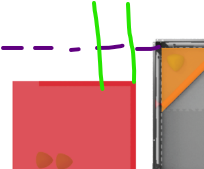
Purple dashed line is the extension of the side field wall, marking the edge of the space directly behind the field wall Green lines are legs of a hypothetical Drive Team Member
Respondido por committee
- Yes.
- This decision should be made by a Head Referee and/or Event Partner, primarily based on safety and the location of the field.
- Figures 1 & 2 in the game manual--as well as sheets 1, 2, & 3 of 15 in Appendix A-- show the intended positions and general size of the Alliance Stations. While specific measurements are not provided, it is expected that those general locations and sizes are used at all events.
1821: Transitive Triball contact while match loading
While match loading, a team contacts a triball in the possession of their robot (let's call this triball P) with a triball that they are holding and attempting to match load (let's call this triball H). Considering <SG6>, <S1>, <G9>, and/or <G17>, which violations (if any) should the referee rule in the following situations:
- Triball P is currently being launched out of the robot by a mechanism and hits triball H. Triball H:
a) stays in the students hands
b) lands in the opposing alliances offensive zone
c) lands in the teams offensive zone
d) lands in the teams match load zone
e) leaves the students hand and goes out of the field
- Triball P is currently being launched out of the robot by a mechanism and hits triball H. Triball H falls into the field and the student instinctively or on purpose picks up the ball and uses it as the next matchload:
a) from the teams matchload zone
b) from the opposing alliances offensive zone
- Triball P is only briefly touched by triball H. Triball P remains possessed by the robot and:
a) does not move at all/significantly
b) moves within the robot i.e from the catapult to the intake
- Triball P is knocked off the robot with triball H so that it is no longer possessed
Also, should any of the triballs in the above scenarios be considered 'out of the field' and placed into the match load zone by the head referee?
Matthew and Kieran UK refs
Respondido por committee
Please review Q&A 1778, specifically regarding the introduction of Match Loads one at a time.
If we are understanding correctly, these scenarios all imply that a Drive Team Member was introducing a second Match Load before the Robot had launched its first one. These are good examples of what could happen if the "one Triball at a time" rule is not followed. So, at a minimum, all scenarios would warrant a warning / Minor Violation of <SG6> Note 2.
Since these are now considered "improper Match Loads", this similar Q&A applies. If an event has the resources to do so, one application of this Q&A is to count the number of illegal Match Loads, and determine if this quantity could have a Match Affecting result.
With that being said, due to the safety implications of this particular form of illegal Match Loading (i.e., a Drive Team Member has literally been hit by a Match Load), a more rapid escalation may be appropriate at the Head Referee's discretion.
1777: [Official GDC Q&A Post] How do I judge if a Match Load maneuver is unsafe?
<SG6> Match Load Triballs may be safely introduced during the Match under certain conditions. For the purpose of this rule, “introduce” refers to the moment when a Match Load Triball is no longer in contact with a human and has crossed the plane of the field perimeter.
During this action, a Drive Team Member’s hand may temporarily break the plane of the field perimeter. This momentary interaction is an exception to rule <G9>. Excessive, unnecessary, or unsafe actions while introducing a Match Load may be considered a Violation of <S1> and/or <G1> at the Head Referee’s discretion.
There have been reports of confusion regarding how to determine if a given Match Load maneuver is excessive, unnecessary, or unsafe. This post will provide some guidelines and best practices that should help Teams and Head Referees evaluate these scenarios at an event.
Respondido por committee
Generally speaking, our intent for SG6 has always been to encourage creative/unusual strategies. We want this rule to be as much “anything goes” as possible, within two bounds:
- Avoid irresponsibly unsafe actions.
- “Robots play the game, not humans.”
This Q&A post will be discussing point 1. Information regarding Point 2 can be found in this related Q&A post.
First, please see this previous Q&A for some initial background: https://events.vex.com/VRC/2023-2024/QA/1553
If a Team chooses to compete with a design or strategy that could risk being considered unsafe, they should be prepared to demonstrate any safety precautions or considerations that have been taken, such as during inspection or a practice match. We would encourage Head Referees and Event Partners to take these conversations seriously, and provide Teams with some degree of "benefit of the doubt" when it comes to their own Robots.
With that being said, there is a limit to that consideration, and Teams should also be prepared for the possibility that a Head Referee will not agree that their precautions are sufficient.
This sentiment still represents our intent for SG6/S1. Yes, creative strategies are encouraged ... if a team has done their due diligence of recognizing, preparing for, and addressing any risks involved.
To be clear: the vast majority of teams that we have witnessed this season have been acting within the GDC’s intent for “acceptable” Match Load behavior. However, as the level of play increases, so too are concerns about teams “pushing the limits”, and we would like to provide some further guidance as we head towards the second half of the season.
1: The Good:
The following examples, although not explicitly required, may help to demonstrate acceptable preparations / precautions:
- Using non-functional decorations, such as tape or foam, to cover exposed sharp edges
- Using sensors to prevent mechanisms from moving if a Triball is not in place
- Wearing fitted gloves, tying back long hair, etc.
- Strategies/designs which minimize the impact of defensive interactions from other Robots (e.g., brakes, bracing against the field wall)
- Calm, consistent, clearly planned and practiced Drive Team Member in-match procedures
2: The “Probably Fine”:
The following examples depend heavily on context. Essentially, this list says: “We know these are occurring, and acknowledge that there could be risks associated with them if done carelessly. However, we have seen enough evidence at this point in this season to feel that these risks can be easily mitigated with robust design and practice.”
- Placing a Drive Team Member’s hand “into” the volume of a Robot (legal example)
- Mechanisms which are abnormally large, fast, or powerful
- Two Drive Team Members loading in rapid succession, such that two incoming Match Loads (or hands) are never past the field perimeter at the same time (legal example)


3: The Bad:
The following examples, although not explicitly Major Violations on their own, toe the line of acceptable “risk tolerance”. They likely indicate a sub-par level of caution on the Team’s part, especially if repeated or if multiple items are combined, and will likely draw a warning from the Head Referee on the grounds of <S1>, <R5>, <SG6>, <G9>, or <G1>.
- Any action which involves placing a Drive Team Member’s head over / near / in front of a Robot
- Mechanisms which are visibly unstable or have a history of breaking during Matches
- Mechanisms which have caused injury to a Drive Team Member in a previous Match
- Two Drive Team Members loading in rapid succession, such that two incoming Triballs (or hands) are past the field perimeter at the same time, or such that an error made by one person could cause the other to be hit by a Triball / mechanism (illegal example)
- A Robot design which requires repeatedly reaching further than one field tile away from the Match Load Zone (illegal example)
- Introducing Match Loads from the side of the field that is not coincident with the Alliance Station

1773: Matchload onto a Flywheel
<S1>Is it legal to introduce a match load triball by dropping it onto a moving flywheel that shoots it across the field? The drop would be from a distance of 10 to 20 inches.
Similar to this video https://www.youtube.com/shorts/6kv0CMhia6U
Respondido por committee
Please see Q&A 1778 for our response to this and other recent questions about the legality of hypothetical match load devices & strategies.
1695: Accidental damage the Field
<S1> Stay safe, don’t damage the Field. If, at any time, the Robot operation or Team actions are deemed unsafe or have damaged any Field Elements or Blocks, the offending Team may be Disabled and/or Disqualified at the Head Referee’s discretion. The Robot will require re-inspection before it may again take the Field.
<G7> Don’t damage the Field. Robot interactions which damage the Field or any Field Elements are prohibited.
Violation Notes: -In most cases, accidental Field damage should only be considered a Minor Violation / formal warning
Here are two rules related to damaging the field. The problem we face is that the two vertical red VEX IQ beams in two of the corners of the supply zone are easily broken. In a match, as we approached the supply zone, we accidentally hit and broke the red beam. The referee ruled that we damaged the field and caused a change in the score (5 points for partially parking). Consequently, we received a DQ. However, we believe that we had partially parked before causing the damage to the Field, and it occurred by accident. It should be considered a minor violation.
![[Example Image]](https://events.vex.com/storage/markdown/uploads/I9kCmXO8TADDtlJCEnaZwC8x9OMpgrzxYp1FPiOp.png)
The red beam can fall off just from a light touch. If the team's robot accidentally breaks the red beam while retrieving blocks in the supply zone or while parking, would it be classified as a minor violation or a major violation?
If considered a major violation, is it due to the rules outlined in <S1>, or is it upgraded to a major violation because of a minor violation under <G7> that results in a change in score?
Thank you for your reply.
Respondido por committee
Because the red beams you've described can easily be knocked loose during normal game play, Head Referees are encouraged to follow the Violation Notes for rule <G7> and record accidental damage as a Minor Violation. The Head Referee should encourage Teams to be careful while in proximity to the red beams in order to avoid repeated Minor Violations.
*In most cases, accidental Field damage should only be considered a Minor Violation / formal warning
The Head Referee has some discretion if they feel the damage was egregious or intentional.
*Egregious, intentional, or repeated accidental / Minor Violations may escalate to a Major Violation at the Head Referee’s discretion
1590: Field Tolerances Impacting Gameplay
(via team 920B) <T10> [...] Field Element tolerances may vary from nominal by up to ±1.0” <T7> Match Affecting “field fault” issues. [...] iii. Field Elements detaching or moving beyond normal tolerances (not as a result of Robot interactions). Grant Cox (chairman of the GDC) clarifies here (https://youtu.be/V0fb47-Zd5Q?t=37) that the goals should be built such that you cannot easily roll the triballs into the goals; they must be pushed with a reasonable amount of force to get them under the PVC bar that defines the outside of the goal. After much experimenting with the field and observing other fields, it has become apparent to us that sometimes the vertical PVC pipes on the corners of the goals will sometimes become raised up due to intense robot interactions. This drastically changes how triballs interact with the goal, namely how easy they roll under. With this and the above rules in mind, we would like some clarification as to how these rules should be interpreted in certain situations. We are not looking for a blanket ruling, and we know that it is impossible to issue one. Instead, we would like a ruling on what the correct ruling should be in the following situations (assuming no other rules are being violated): Situation 1: A robot is pushing triballs into their alliance goal in an act of reasonable normal gameplay. As they are doing so, the vertical PVC pipe in one of the corners of the goal loosens up a little bit and raises up ¾”. Since it is still within the ±1” allowable tolerance, it is not in violation of <T10>. However, it now allows triballs to be easily rolled under the net from several feet away, such that they don’t even contact the horizontal PVC pipe. This does not meet any of the criteria of <T7a>, so the way I read the rule, no replay should be awarded. However, one alliance clearly had an advantage due to their goal being raised up allowing for easier scoring in the goal. After the match, it is determined that the alliance who had the goal that raised up ¾” won, but only because the goal had become raised up. The head referee recognizes this as affecting the outcome of the match, but cannot classify it as match affecting as it does not violate <T7>. What should be done? Should the match be replayed (if so, under what rule)? Should the team that caused the goal to raise up be given a warning (if so, how should the referee determine which robot to penalize)? Situation 2: A robot at the beginning of the match intentionally presses upward on the goal, causing the vertical PVC pipe to slide ¾”, causing the outcome described in Situation 1 (including the head referee determining that it did affect the outcome of the match). The robot did utilize the fact that triballs can easily be rolled into the goal. Does the fact that it was intentional change any of the answers to the questions in Situation 1? Situation 3: The head referee determines after a match has ended that the match had begun with one of the goals raised up ¾” as described in Situation 1. It leads to the same outcome as in Situation 1, where the head referee sees that it did affect the outcome of the match. Situation 4: After a match, the head referee sees that one of the alliance goals is ¾” lower than normal (they are unsure how or when it happened). It is still within the ±1” tolerance set by <T10>. However, this impacts the ability to score triballs in the goal so much that the head referee determines that it did severely affect the outcome of the match. From my observations, it would be unsafe and likely to damage triballs (in violation of <S1>) to design and compete with a mechanism capable of pushing triballs under the bar if it were ¾” lower than normal. What should be done in this situation? Should the match be replayed (if so, under what rule)? Or should the outcome of the previous match just be left as-is and the field be fixed for the next match? Again, we are only looking for answers to these specific situations, not a blanket answer (as we know you cannot provide one). Assume no other rules are being violated in these situations. Thank you for your time and consideration.
Respondido por committee
Thank you for your questions. We’ll start by noting that the tolerances for the opening of the Goal between the PVC pipe and the foam tiles was revised to +0.25” / -0.00” in version 1.0 of the game manual on June 27, 2023. This change predated your Q&A post and has a significant impact on your scenarios. As always, we encourage users to review and follow the Q&A Usage Guidelines, which include "Quote the applicable rule from the latest version of the manual in your question. Often, you'll find that by quoting the rule, you'll answer your own question.”
In all scenarios in which the Goal is or becomes out of tolerance due to normal gameplay or incorrect assembly (including your Situations 1, 3, & 4) a Match replay may be warranted under clause aiii of rule <T7>, “Field Elements detaching or moving beyond normal tolerances (not as a result of Robot interactions),” at the discretion of the Head Referee and Event Partner. In these scenarios, no Teams should be penalized.
In scenarios in which the Goal is moved out of tolerance intentionally (including your Situation 2), would merit a Major or Minor <S1> Violation depending on whether the Head Referee determines that the Violation is Match Affecting or not.
To keep events on schedule, Teams that are concerned about a Goal height should notify the Head Referee or event staff prior to the Match.
1553: Loading a moving catapult arm
Rule SG6 allows a human player to place a Match Load gently onto a Robot from the Drive Team Member’s Alliance. We have observed several instances where a human is reaching out to place a Triball in a robot's catapult. How does rule SG6 interact with rule S1. Specifically, does rule S! require that the catapult arm be stationary when the Triball is being loaded? We stopped several teams from loading Triballs in a catapult arm that was continuously snapping forward and back, as students had trouble timing the placement of the Triball to avoid having their hand hit by the moving catapult.
There are very many rules this year that are settled only by the judgement of a head referee at an event. Should rule SG2 require that the catapult arm be stationary when the Triball is being loaded to avoid having different referees rule differently on what is considered unsafe under S1?
Respondido por committee
We believe our response to Q&A 1529 addresses your question.
There are very many rules this year that are settled only by the judgement of a head referee at an event. Should rule SG2 require that the catapult arm be stationary when the Triball is being loaded to avoid having different referees rule differently on what is considered unsafe under S1?
To expand further on this subject, it is important for both Teams and Head Referees to remember that Teams are responsible for the actions of their Robots at all times. <S1> typically refers to actions that pose an active danger to (or that have injured/damaged) other Students, volunteers, or field elements. The Game Manual does not typically legislate specific conditions for what is considered "unsafe", due to the inherent risks involved in designing and building Robots that have limitless possibilities for spinning wheels, pinch hazards, and sharp edges.
If a Team chooses to compete with a design or strategy that could risk being considered unsafe, they should be prepared to demonstrate any safety precautions or considerations that have been taken, such as during inspection or a practice match. We would encourage Head Referees and Event Partners to take these conversations seriously, and provide Teams with some degree of "benefit of the doubt" when it comes to their own Robots.
With that being said, there is a limit to that consideration, and Teams should also be prepared for the possibility that a Head Referee will not agree that their precautions are sufficient. In this context, we would direct Teams to the following notes from the Game Manual.
Rule <G3>:
When in doubt, if there is no rule prohibiting an action, it is generally legal. However, if you have to ask whether a given action would violate <S1>, <G1>, or <T1>, then that’s probably a good indication that it is outside the spirit of the competition.
Rule <SG6>:
Excessive, unnecessary, or unsafe actions while introducing a Match Load may be considered a Violation of <S1> and/or <G1> at the Head Referee’s discretion.
Rule <R3>:
All Inspection Rules are to be enforced within the discretion of the Head Referee within a given event. Robot legality at one event does not automatically imply legality at future events. Robots which rely on “edge-case” interpretations of subjective rules, such as whether a decoration is “non-functional” or not, should expect additional scrutiny during inspection.