Q&A
VEX V5 Robotics Competition 2026-2027: Override
Marcado: GG17
Welcome to the official VEX V5 Robotics Competition Question & Answer system, where all registered teams have the opportunity to ask for official rules interpretations and clarifications. This Q&A system is the only source for official V5RC rules clarifications, and the clarifications made here from the Game Design Committee (GDC) are considered as official and binding as the written Game Manual itself.
Please review the Q&A Usage Guidelines before posting. This system is only intended for specific V5RC game rules questions.
- For event, registration, or other competition support questions, please contact your Program Support Manager.
- For VEX technical support, contact [email protected] or [email protected].
- For game questions, suggestions, or concerns outside of specific and official rules questions, contact [email protected]
Indexação
- Regarding hidden wedge
- When to Wave Off the Holding Call
- Pushing Robots Around the Field
- <GG9> <GG15> <GG17> <SG10> Priority Call for a Head Referee
- Is trapping an opponent to prevent a descore legal?
- GG17 Definition of "Match Affecting"
- When should a Holding Violation escalate from minor to major? <GG17>
- Robot Stability and Rule <GG14>
- <GG17> Starting a Holding Count
- Trapping between the Field Perimeter and a Long Goal
- Holding against the Park Zone
3044: Regarding hidden wedge
<GG17>Our team participated in the Rodeo Signature Event. After the finals, we learned from another Ruiguan robot driver about a mechanism that caused us to lose all of the pushing competitions during the final matches.
The issue lies in a specific Ruiguan robot design feature: an extremely low and wide polycarbonate aligner mounted at the rear of the robot. During pushing matches, these robots do not attempt to engage head-to-head in a straight, parallel push. Instead, the driver intentionally avoids direct alignment and uses the rear polycarbonate aligner to wedge into one side of the opponent’s drivetrain wheels. This maneuver slightly lifts the opponent’s wheels off the ground, causing a loss of traction and power, allowing the Ruiguan robot to win the push or pin. This action occurs very quickly and often within three seconds.
Many drivers are aware of this technique, even though some teams may simply copy the design without fully understanding how to exploit it. Another tactic we were told about involves maximizing the size of the polycarbonate aligner. When the aligner is sufficiently large, even during a standard pushing interaction, one side of the opponent’s drivetrain or rear wheel can ride up onto the polycarbonate surface, resulting in a loss of traction without requiring precise driver control.
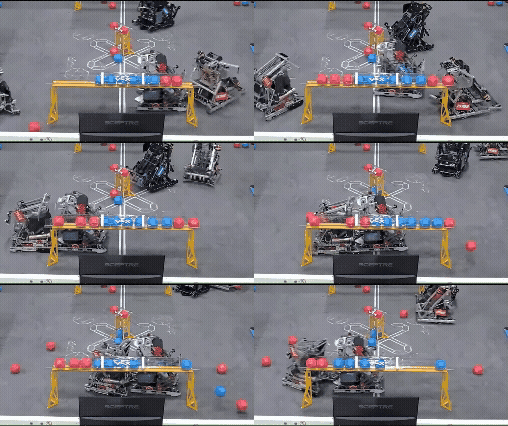
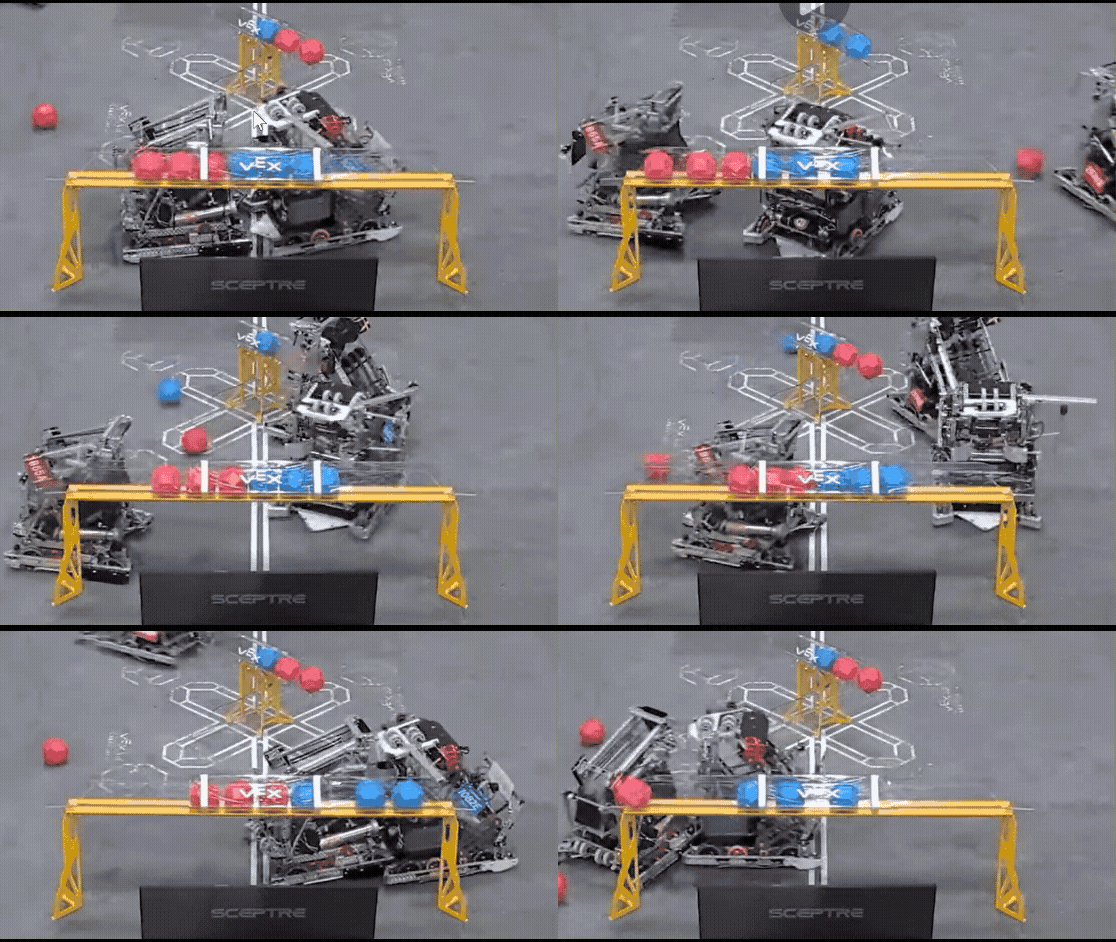
The first video below shows a clear example of this strategy. The blue Ruiguan robot was expected to push straight toward the red robot on the left to defend their blue balls. Instead, it deliberately reversed, moved to the top position (surprisingly away from the long goal), and then made a sharp right-angle turn to attempt to wedge the white and large polycarbonate aligner into one side of the red robot’s drivetrain. We avoided the initial attempt by backing away, which allowed us to push them back successfully. However, the blue robot then repositioned strategically and successfully wedged its polycarbonate aligner into our rear wheel, causing our drivetrain to lose power and ultimately resulting in our loss.
The second video below shows another clear example of this strategy. The blue Ruiguan robot repeatedly reverses to a top position (away from the long goal) at a specific angle and then makes a sharp right-angle turn to wedge the polycarbonate aligner into one side of the red robot’s drivetrain. Although we attempted to avoid having our wheels ride onto the polycarbonate, there was no way to avoid it as the polyarbonate is "huge".
So our questions are: Is this kind of wedge legal or not, as it is a design that could be used intentionally to lift other robots? In addition, is this kind of short lift (usually less than three seconds) legal or not? Thank you.
Respondido por committee
Lifting a robot is not, itself, against the rules. Neither is the wedge employed by the Robot in your question. See the definition of Holding and the details of rule <GG17>.
Lifting only becomes a Violation if it meets the game manual's definition of Lifting (controlling an opponent’s movements by raising or tilting the opponent’s Robot off of the foam tiles) and lasts longer than the allowed 3-count for Holding in rule <GG17>.
Lifting that meets the definition of Holding and extends beyond the limits in <GG17> is at least a Minor Violation, and can result in a Disqualification if the Head Referee determines that the Violation was Match Affecting.
3042: When to Wave Off the Holding Call
Example: BLUE1 pins RED1 and a count begins. BLUE1 backs off before 3 seconds and attempts to separate 2 feet away. RED1 maneuvers to remain within 1 foot of BLUE1 under their own choice, never allowing the distance to be maintained for 5 seconds.
If the ref can tell BLUE1 is actively trying to separate and doesn't resume pinning, should the 5 seconds be waved off, or should it remain?
Respondido por committee
A Holding or Pinning count can be waved off as soon as the interaction moves approximately 2 feet from where it began (see <GG17> clause B), unless another Holding interaction occurs within a 5-second reset count.
As described in <GG17>, If a Team resumes Holding the same Robot within that 5-count, the original Holding count will resume from where it ended.
3002: Pushing Robots Around the Field
According to rule <GG17>, teams are not allowed to Hold other Robots for more than a 3 count. Does pushing Robots around the field count as Holding, and would it count towards a penalty?
The definition of Holding includes Trapping, Pinning, and Lifting.
Trapping is "Limiting the movement of an opponent Robot to a small or confined area of the Field, approximately the size of one foam field tile or less, without an avenue for escape." This does not apply in this scenario as the pushed Robot would be moving outside of a space approximately the size of one foam tile.
Lifting is "Controlling an opponent's movements by raising or tilting the opponent's Robot off of the foam tiles.” This also does not apply, as the Robot getting pushed will just slide across the Floor and not get tilted or raised.
Pinning is the only one left, and it is not as clear whether or not this one counts. It says "Preventing the movement of an opponent Robot through contact with the Field Perimeter, a Field Element, or another Robot." Under the definition of a Field Element is the Field. The Field consists of the Floor. The definition of the Floor includes all the foam tiles. In the case of pushing, this rule could be interpreted as preventing the individual free will movement of an opponent Robot using [Foam Tiles], which in this case would be considered Pinning.
Even if this is considered Holding, In rule <GG17b>, it says that a way for the Holding count to pause is if "Either Robot has moved at least two (2) feet away (approximately one tile) from the location where the Trapping or Pinning count began." This will be fulfilled when the pushing Robot moves with the pushed Robot more than two feet away from the starting point of contact. So would pushing of any kind (That does not tip a Robot) be completely legal? If not, here are some scenarios that might differ in that answer:
(All these scenarios are different and might change the legality of pushing based on rule <GG15> which states that "Offensive Robots get the "benefit of the doubt.""
Scenario 1: RED1 is trying to score on a goal, when BLUE1 pushes them more than two feet out of the way to stop them
Scenario 2: RED1 is sitting at the end of a goal attempting to prevent the BLUE team from scoring, but BLUE1 pushes RED1 more than two feet away and goes to score.
Scenario 3: RED1 is scoring at a goal, and BLUE1 is coming up to them to push them out of the way. RED2 then pushes BLUE1 more than two feet away to stop them from being defensive and preventing their ally from scoring.
None of these scenarios are match affecting.
What is the legality of these scenarios, what would be the penalty for all of these, and will the rules change to change the previous two answers or not?
Respondido por committee
There is no rule that prohibits pushing another Robot if the interaction doesn't lead to intentional damage, tipping, or Entanglement (<GG14>) or the definitions of Trapping, Lifting, or Pinning (<GG17>). Pushing a Robot across the foam tiles does not count as Pinning them to those tiles (<G3>).
The gameplay described in all of your scenarios is legal, and none of the Teams should be penalized.
And no, we do not intend to change the rules to make pushing illegal.
2969: <GG9> <GG15> <GG17> <SG10> Priority Call for a Head Referee
Good Evening GDC,
After some discussion, we are looking to determine if a Head Referee should focus first on an < SG10 > violation or on a potential hold < GG17 > of the robot committing the < SG10 > violation.
For an example:
- RED1 goes to descore a goal and inserts its arm into the open section as allowed, with no current violations of < SG10 >
- With the new definitions of defensive and offensive on 12/4, RED1 becomes defensive ("descoring in a way that doesn't increase points for the Robot's own Alliance")
- BLUE1 goes over to prevent the descore of the blocks in the goal
- RED1 has their arm still in the open section of the goal and claims that they are being held "pinned" by BLUE1 (in this instance, they no longer are actively moving blocks in the goal, thus they are now goalkeeping)
If RED1 were to remove their arm from the open portion of the goal, a hold count would be started instantly in this situation because it is clear to the Head Referee that RED1 wants to leave the area now, rather than stay there and continue descoring objects.
If RED1 is not actively moving blocks, they are in violation of < SG10 > and need to remove their arm from the goal immediately as they are goalkeeping.
The question becomes is should a hold count be started by the Head Referee immediately when this situation occurs, or should RED1 remove their arm from the goal first to remedy the < SG10 > violation?
The assumption is that the < SG10 > violation should be resolved first due to RED1 above being the defensive robot, getting no "benefit of the doubt" from < GG15 >, as written in < SG10a >.
Thank you for your time, Cowboy
Respondido por committee
In your scenario, BLUE1 is playing more Defensively than RED1 (BLUE1 is making no attempt to move Blocks), so the Holding should be considered before any possible Goalkeeping.
RED1 is reaching into the Goal and actively moving blocks, and BLUE1 moves in to hold them. A Holding count should begin immediately. BLUE1 can legally hold RED1 for a 3-count before they must separate.
If BLUE1 backs off after a 3-count, and RED1 removes their arm from the Goal when they're able, neither Robot should get a Violation.
If BLUE1 continues Holding beyond a 3-count, they should get a <GG17> Violation.
If RED1 is Goalkeeping after blue departs, RED1 should get an <SG10> Violation.
2941: Is trapping an opponent to prevent a descore legal?
We reviewed Q&A 2744 regarding trapping near a Long Goal. Our question adds a scenario where the trapped robot is actively attempting to descore. Does this intent affect the Holding count or legality of prolonged immobilization?
Trapping (Game Manual 2.1) - Limiting the movement of an opponent Robot to a small or confined area of the Field, approximately the size of one foam field tile or less, without an avenue for escape. Note that if a Robot is not attempting to escape, it is not considered Trapped.
GG17: A Robot may not Hold an opposing Robot for more than a 3-count during the Driver Controlled Period. The count begins immediately once the Head Referee observes a suspected Holding interaction.
Rule <GG17>
Q&A 2744: Clarified that if two Robots work together to trap an opponent between the Field Perimeter and a Long Goal, the Holding count and subsequent violation apply if the count exceeds three.
(https://events.vex.com/V5RC/2025-2026/QA/2744)
Does this change under the scenario below?
Scenario
- A Blue Robot is positioned behind a Long Goal filled with Red Blocks.
- The Blue Robot deploys a mechanism to legally descore blocks.
- Two Red Robots “sandwich” the Blue Robot so it cannot move in any direction, preventing descoring.
- The Blue Robot actively attempts to escape but cannot move.
Question:
- Does the Blue Robot’s intent to descore change whether a Holding count should start?
- If not, would the two Red Robots be allowed to keep the Blue Robot from moving for the remainder of the match if strategically advantageous?
![[Example Image]](https://events.vex.com/storage/markdown/uploads/d3h4PzOQXJ1KzO8BxEFLi3Jkg45Zy26kp5HrHuRI.png) Figure: Blue Robot attempting to descore is trapped between two Red Robots and the Field Perimeter
Figure: Blue Robot attempting to descore is trapped between two Red Robots and the Field Perimeter
Respondido por committee
The interaction you've described counts as Holding, and is subject to the limitations in rule <GG17> and all related Q&As. Regardless of what the held Robot is trying to do, and as long as they're actively trying to escape, they must be given freedom to move after a 3-count.
2927: GG17 Definition of "Match Affecting"
In Push Back, we frequently see scores change rapidly, which causes teams to adjust their strategy throughout the match based on the current score. I would like clarification on how “match affecting” is determined when a major violation occurs early in the match and significantly impacts a team’s ability to execute their intended strategy.
Scenario:
Team A nearly fills an upper goal during autonomous and continues to score into it once driver control begins.
Team B moves toward the upper goal to begin descoring.
Team A initiates a holding violation that exceeds the referee’s 3-count.
After Team A releases them, Team B attempts to resume their descoring actions, only to find Team A has repositioned to block the opposite side of the goal.
If Team B had not been held past the 3-count, they would have begun descoring earlier. This earlier access to the goal would likely have changed their strategy for the remainder of the match.
I have read and understand that “match affecting” is determined by comparing the final score to a hypothetical score had the violation not occurred. However, in cases like this, the majority of the match may have unfolded differently because of the violation, even if the final score does not directly reflect this impact.
Request for clarification: Should “match affecting” be evaluated solely based on the final score outcome, or should referees also consider whether a violation materially changed the strategic flow of the match at the time it occurred?
Thank you for your guidance.<GG17>
Respondido por committee
Thanks for your question, Dale, and for your patience as we considered our answer.
As described in the game manual's definition of Match Affecting, "When evaluating if a Violation was Match Affecting, Head Referees will focus primarily on any Robot actions that were directly related to the Violation."
In most cases, it is impossible for a Head Referee to accurately know what a Team "would have done" if a Violation hadn't occurred. It is likely that every Violation has an impact on the strategic flow of the Match, but that impact cannot be quantified in a consistent, fair, or simple way that can be used for every Match at every event.
When evaluating whether a Violation was or wasn't Match Affecting, the Head Referee's decision should be based solely on the final outcome of the Match.
Side note that doesn't apply to <GG17> and Holding, but does apply to many other rules: In many cases, we've included specific Violation notes that should be considered by Head Referees prior to a Match Affecting decision. For Violations of those rules, Head Referees are asked to assess the Violation's impact on the Match (e.g., was it egregious?), and the likely intent of the Team that committed the Violation (e.g., was it intentional or strategic?).
2827: When should a Holding Violation escalate from minor to major? <GG17>
Note: The GDC revised this question and its title to better reflect the definitions and processes in the game manual.
Red 1 holds Blue 2 for a 3-count, per <GG17>, then the following scenarios happen:
- Red 1 continues to hold Blue 2 for an additional 1-count, for a total of 4
- Red 1 continues to hold Blue 2 for an additional 3-count, for a total of 6
- Red 1 backs away for a 4-count, and then resumes a hold on Blue 2 for an additional 1-count, for a total of 4
Which of these should be minor violations, and which should be major?
When determining whether the violation is match affecting, should the Head Referee consider the actions Blue 2 could have made for the total count or only the additional time exceeding the initial 3-count?
Respondido por committee
Thanks for your question, Nathan!
We'll start with some tried and true boilerplate GDC language from prior seasons that is still true today. It is impossible to issue a blanket answer beyond what is written in the game manual that encompasses all possible situations based on a snapshot description of a hypothetical interaction. This ruling, and the determination of whether it's a Minor or Major Violation, must be made by the Head Referee based on the context of the Match.
However, absent any other case-by-case context or extenuating circumstances, we can provide some general guidance on what a Head Referee could consider when deciding whether a Holding Violation is Minor or Major. Factors that could affect the ruling include:
- How much extra time was included in the Holding interaction
- How long the Robots were separated if the Holding Robot backs away and returns too early
- What both Robots were doing within the larger context of the Match
- Holding is an inherently defensive action, so rule <GG15> may also be considered if a judgment call is required
It is difficult for a Head Referee to know exactly what actions a Robot "would have taken" if a Holding action had ended correctly after a 3-count, so we can't tell referees how to determine whether the Violation was or wasn't Match Affecting. Because the first three seconds of a Hold are legal game play and not a Violation, only the extended portion of a Hold should be considered.
Regarding your scenarios, depending on the circumstances of the Match a Head Referee could reasonably decide that any of them were Major Violations. Scenario 2 is the most likely to be considered a Major Violation, as it's double the length of a legal Holding interaction regardless of any other factors.
2808: Robot Stability and Rule <GG14>
Scenario: Robot Red A plays defense and their design is prone to entanglement during interactions. In multiple previous matches, referees have observed RED A tipping or becoming entangled after minor contact with different opponents.
During a Qualification Match, RED A plays defense against Robot Blue A. In the course of a normal pushing interaction, Robot Red A flips over.
Question: According to rule <GG14>, should Robot Blue A receive a penalty for tipping its opponent, given that the interaction was a normal part of gameplay and Robot Red A's design is known to be unstable? Any violation for RED A?
Respondido por committee
Thanks for your questions, Tina!
Clause B of rule <GG14> says, "Some incidental tipping, Entanglement, and damage may occur as a part of normal gameplay without Violation. It will be up to the Head Referee’s discretion whether the interaction was incidental or intentional."
Clause C says, "A Team is responsible for the actions of its Robot at all times, including the Autonomous Period. This applies both to Teams that are driving recklessly or potentially causing damage, and to Teams that drive around with a small wheel base. A Team should design its Robot such that it is not easily tipped over or damaged by minor contact."
In your scenario, Robot BLUE A generally shouldn't get a Violation for tipping RED A in a normal pushing interaction, although the final ruling has to consider the context of the Match.
If RED A has a history of entanglement, it could be reasonable for a Head Referee to give them a Minor or Major <GG14> Violation depending on the circumstances and duration of any entanglement with opponents during a Match.
We hope this helps!
2775: <GG17> Starting a Holding Count
Per V2.0 of the Game Manual:
Holding - A Robot status; see rule <GG17> for more information. Holding is legal until it exceeds the limits in <GG17>. A Robot is considered to be Holding if it meets any of the following criteria during a Match:
Trapping - Limiting the movement of an opponent Robot to a small or confined area of the Field, approximately the size of one foam field tile or less, without an avenue for escape. Note that if a Robot is not attempting to escape, it is not considered Trapped.
Pinning - Preventing the movement of an opponent Robot through contact with the Field Perimeter, a Field Element, or another Robot.
Lifting - Controlling an opponent’s movements by raising or tilting the opponent’s Robot off of the foam tiles. Preventing a Robot that is already off of the Floor from returning to the Floor may also be considered Lifting or Trapping.
<GG17> No Holding for more than a 3-count. A Robot may not Hold an opposing Robot for more than a 3-count during the Driver Controlled Period. For the purposes of this rule, a “count” is defined as an interval of time that is approximately one second in duration, and “counted out” by Head Referees verbally. A Head Referee should begin a Holding count immediately when Holding is observed. The Holding count should pause when at least one of the following conditions is met:
a. The two Robots are separated by at least two (2) feet (approximately one foam tile).
b. Either Robot has moved at least two (2) feet away (approximately one tile) from the location where the Trapping or Pinning count began.
- i. In the case of Lifting, this location is measured from where the Lifted Robot is released, not from where the Lifting began.*
c. The Holding Robot becomes Trapped or Pinned by a different Robot.
- i. In this case, the original count would end, and a new count would begin for the newly Trapped or Pinned Robot.*
d. In the case of Trapping, if an avenue of escape becomes available due to changing circumstances in the Match.
After a Holding count ends, a Robot may not resume Holding the same Robot again for a 5-count. If a Team resumes Holding the same Robot within that 5-count, the original Holding count will resume from where it ended. A Head Referee should use fingers to display the 5-count that occurs after the end of a Holding count, and “wave it off” after the Holding interaction has been cleared.
According to <GG17> "A Head Referee should begin a Holding count immediately when Holding is observed."
There are two ways this could be interpreted:
- As soon as the Head Referee verifies that the robot in question meets the status as outlined in the definition of Holding, then the count should begin. (This would take about 2 seconds depending on the situation)
- As soon as the Head Referee observes two robots in close proximity to the point where it may be considered Holding, a count should begin, with the verification happening afterwards. (Could be an issue with the limit of a 3-count instead of 5-count)
What is the GDC's stance on this interpretation?
Thank you, Cowboy
Respondido por committee
Thanks for your question, Cowboy!
A Holding count should begin immediately once the Head Referee observes a suspected Holding interaction. We acknowledge that processing the details of a Robot interaction within the reduced count duration may prove to be challenging.
Starting a Holding count is not, in and of itself, a declaration that Holding is occurring. Ending a Holding count early and waving it off is also not, in and of itself, an indication that Holding has occurred. There is no harm in reacting quickly with a Holding count, realizing that no Holding is occurring, and then ending and waving off the count.
During a Holding count, the Head Referee should continually verify that the interaction meets the definition of Holding. If it becomes clear that the interaction doesn't meet the definition of Holding, the Head Referee should end the count early and wave off the Holding count. Holding only becomes a Violation if a referee exceeds a three-count before the Robots separate as described in rule <GG17>.
We will attempt to clarify this in the next game manual update, and we hope this answer helps!
2744: Trapping between the Field Perimeter and a Long Goal
In the general definitions, Trapping is defined as follows:
Holding - A Robot status; see rule <GG17> for more information. A Robot is considered to be Holding if it meets any of the following criteria during a Match:
- > Trapping - Limiting the movement of an opponent Robot to a small or confined area of the Field, approximately the size of one foam field tile or less, without an avenue for escape. Note that if a Robot is not attempting to escape, it is not considered Trapped.
-
Is underneath the Long Goal, a Field Element with a clearance of 12.53" (320mm), considered an avenue of escape for holding calls?
-
If two robots are working together to Trap an opponent between the Field Perimeter and a Long Goal, which robot(s) should the head ref call out?
-
If the two robots are taking turns Trapping and moving away, when does it become a violation, and for which robot(s)?
Respondido por committee
Is underneath the Long Goal, a Field Element with a clearance of 12.53" (320mm), considered an avenue of escape for holding calls?
If a Robot is being Pinned against a Long Goal, "under the Long Goal" should not be considered an avenue of escape. If a Robot is near a Long Goal but is not physically Pinned against it by an opponent, there is likely an avenue of escape and the interaction is unlikely to qualify as Holding.
If two robots are working together to Trap an opponent between the Field Perimeter and a Long Goal, which robot(s) should the head ref call out?
If two Robots are working together to Trap an opponent, the Holding count (and potential subsequent Violation if the count passes 3) can be applied to both Robots.
If the two robots are taking turns Trapping and moving away, when does it become a violation, and for which robot(s)?
If neither of the Trapping Robots exceeds a 3-count, and if both Robots adhere to the limitations in <GG17>, this strategy can be legal; however, the timing is difficult and the interaction will receive additional scrutiny. Because Holding is a purely defensive action, the Trapping Robots will not receive the benefit of the doubt in a questionable interaction/Violation (see rule <GG15>) and are at risk of a Major Violation and Disqualification.
2743: Holding against the Park Zone
In the general definitions, Trapping is defined as follows:
Holding - A Robot status; see rule <GG17> for more information. A Robot is considered to be Holding if it meets any of the following criteria during a Match:
- > Trapping - Limiting the movement of an opponent Robot to a small or confined area of the Field, approximately the size of one foam field tile or less, without an avenue for escape. Note that if a Robot is not attempting to escape, it is not considered Trapped.
-
Is the Park Zone considered an avenue of escape from Holding?
-
Does the answer change depending on if the Held Robot is able to drive over the plastic extrusions of the Park Zone?
Respondido por committee
Note: This answer has been revised to match the changes to rule <GG17> in the September 4, 2025, game manual update.
It is not the Head Referee's responsibility to know the capabilities of all Robots at an event, and recall which Robots can and cannot drive over the extrusions of the Park Zone.
If a Robot is being Pinned against a Park Zone, preventing movement, it qualifies as Holding and is limited to a 3-count as described in rule <GG17>.
If a Robot is near a Park Zone but is not physically Pinned there by an opponent, the Park Zone should be considered as an avenue of escape and the interaction will not qualify as Holding.