<SG7>
Don’t cross the Autonomous Line, and don’t interfere with your opponents’ actions. During the Autonomous Period, Robots may not contact foam tiles, Blocks, or Field Elements which are on the opposing Alliance’s side of the Autonomous Line.• Blocks that begin the Match in contact with the Autonomous Line are not considered to be on either side, and may be utilized by either Alliance during the Autonomous Period. For the purpose of this rule, all eight Blocks that begin the Match in groups that cross the Autonomous Line are considered to be in contact with the Autonomous Line. See Figure SG-7.
• Teams may interact with the portions of each Goal that are on their Alliance’s side of the Autonomous Line, but may not reach across to interact with the “open” portion of a Goal on their opponents’ side of the Field. A Robot that engages with an open portion of a Goal in proximity to the Autonomous Line is considered to be interacting with the Autonomous Line, and <SG8> applies to any resulting interactions.
• Direct contact with any of the following during the Autonomous Period will result in the Autonomous Bonus and an Autonomous Win Point being awarded to the opposing Alliance, unless they are ineligible through <SC5> clause C: An opponent Robot that isn’t interacting with either the Autonomous Line or objects that begin the Match positioned above or in contact with the Autonomous Line. Blocks on the other side of the Autonomous Line.
• Blocks should only cross the Autonomous Line through Goals. Violations of this clause that affect the opposing Alliance’s autonomous routines will result in the Autonomous Bonus being awarded to the opposing Alliance unless they’re ineligible through <SC5> clause C. Examples of affecting the opposing Alliance could include, but are not limited to, a Block moving another Block out of its starting position so the opponent misses it or a Block crossing the Field and being picked up by an opponent Robot. This clause does not include the Blocks described in clause A.
• Teams that employ deliberate Defensive autonomous strategies that impact their opponents’ autonomous routines in ways not specifically prohibited by previous clauses, such as intentionally placing Blocks on the other side of the Autonomous Line, may be subject to Minor Violations or Major Violations at the discretion of the Head Referees. For example, causing a Block to contact a stationary Robot may be considered a Violation if the Head Referee determines it was a deliberate Defensive action.
The Autonomous Period should be primarily Offensive, with Teams focusing on scoring and executing strategic maneuvers rather than Defensive disruption. Teams should avoid actions that are primarily Defensive in nature and try to prevent impacts to the opponent’s side of the Field.
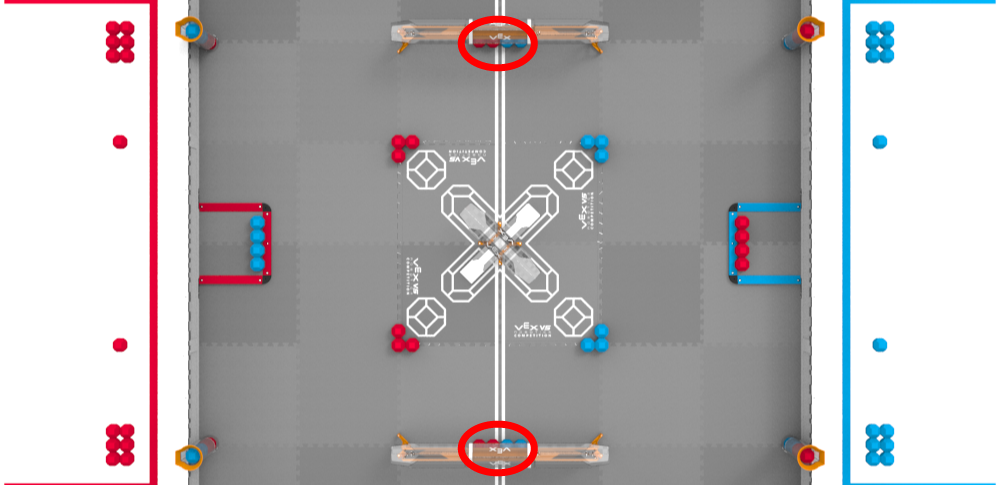
Figure SG-7: These Blocks (circled in red) would be considered to be in contact with the Autonomous Line.
Violation Notes:
• All Violations of this rule (Major or Minor) will result in the Autonomous Bonus being awarded to the opposing Alliance; some also award an Autonomous Win Point. See <SG8> for a potential exception caused by Autonomous Line interactions.
• Intentional, strategic, or egregious Violations, such as intentional or repeated contact with an opposing Robot while contacting the foam tiles on the opposing side of the Autonomous Line, will be considered Major Violations and should result in a Disqualification for the Match.
• Deliberate Defensive Autonomous strategies, as described in clause E, may also be recorded as Major Violations at the Head Referee’s discretion.
• All Violations of this rule (Major or Minor) will result in the Autonomous Bonus being awarded to the opposing Alliance; some also award an Autonomous Win Point. See <SG8> for a potential exception caused by Autonomous Line interactions.
• Intentional, strategic, or egregious Violations, such as intentional or repeated contact with an opposing Robot while contacting the foam tiles on the opposing side of the Autonomous Line, will be considered Major Violations and should result in a Disqualification for the Match.
• Deliberate Defensive Autonomous strategies, as described in clause E, may also be recorded as Major Violations at the Head Referee’s discretion.
Significant Q&As:
• Q&A 2645 - Descoring Blocks from Goals during the Autonomous Period is not a Violation, regardless of what happens to those Blocks afterward
• Q&A 2647 - Intentionally placing Blocks on the opponent’s side of the Autonomous Line is a Violation